

A modular sofa system is defined as a collection of individual seating units that connect together to form a larger sofa, yet each piece functions independently on its own. The industry term you will also hear is “modular sectional,” though “modular sofa system” captures the full flexibility of the concept more accurately. Unlike a traditional sofa, a modular arrangement lets you combine corner pieces, armless chairs, chaises, and ottomans in any sequence you choose. That freedom makes it one of the most practical furniture investments for homeowners and renters who expect their living spaces to change over time. Striped Sofa Co has watched this category grow steadily as more people prioritize adaptability alongside craftsmanship.
What are the key benefits of a modular sofa system?
Modular seating solves a problem that fixed sofas never could: the room changes, but the furniture does not have to. Whether you move from a studio apartment to a three-bedroom house, or simply rearrange for a holiday gathering, a modular system reshapes itself around your life rather than the other way around.
The practical advantages stack up quickly:
- Space adaptability. You can shrink or expand the footprint by adding or removing a single module, making the sofa fit a small rental or a sprawling open-plan living room equally well.
- Easier transport. Modular delivery enables setup in spaces with limited entryways, reducing the risk of damage during transport. Individual pieces pass through narrow hallways and tight stairwells that would stop a traditional three-seater cold.
- Long-term scalability. Owners can expand their seating by purchasing additional modules as living arrangements change, supporting a furniture lifecycle that moves from a small apartment to a larger family home without starting over.
- Sustainability. Buying one system and growing it over time produces less waste than replacing an entire sofa every few years.
- Layout freedom. A modular arrangement can create an L-shape, a U-shape, a straight run, or a freestanding island of seating, depending on what the room calls for that season.
Pro Tip: Sketch your floor plan to scale before ordering. Measure doorways, hallways, and the room itself. The most common regret buyers share is ordering a configuration that fits the room but not the entry.
The advantages of modular seating go beyond convenience. They reflect a shift in how people think about home furnishings: not as permanent fixtures, but as quiet foundations that support the life being lived around them.
What are the different types and components of modular sofa systems?
A modular sofa system is built from a vocabulary of distinct pieces. Understanding each component helps you build a configuration that works rather than one that merely looks good in a catalog image.
The core components include:
- Armless chairs. The workhorse of any modular set. They sit in the middle of a run and can also stand alone as accent seating.
- Corner pieces. These create the turn in an L-shape or U-shape. A single corner unit changes the entire geometry of the arrangement.
- Chaises. A chaise extends one end of the sofa into a lounging surface. It works beautifully in a living room with enough depth to accommodate it.
- Ottomans. Ottomans add flexible footrest or coffee-table function and can close off a U-shape into a fully enclosed seating island.
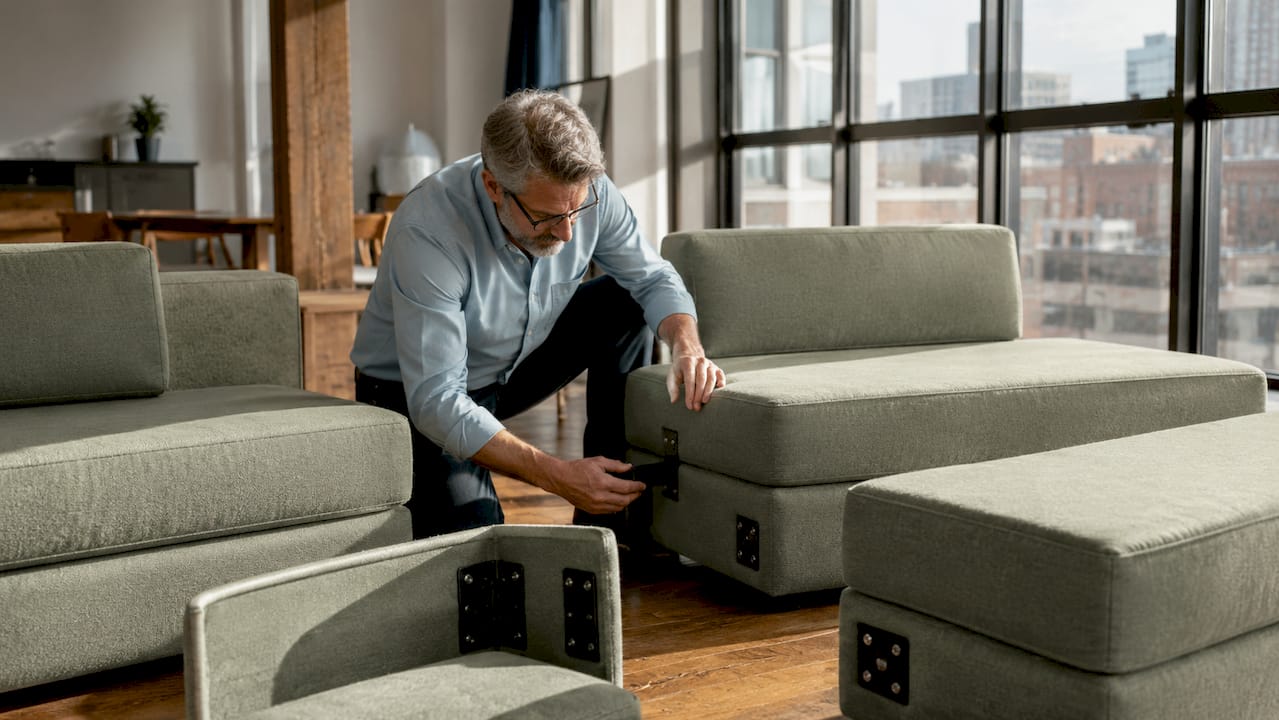
Modular sofas combine these components so that each module connects securely yet separates easily for custom layouts. The connection hardware is what separates a well-made system from a frustrating one.
True modular systems use secure connection hardware such as hidden brackets, alligator clamps, or interlocking clips to prevent modules from drifting apart. Systems without strong connectors fail during daily use, which is the single most common complaint in owner reviews. Some modular sofas feature Velcro-style fixings or hidden hooks that aid in secure connections without tools, making reconfiguration genuinely fast.
Pro Tip: Before buying, ask the retailer specifically how the modules connect. If the answer is vague or the connectors are not shown in product photography, treat that as a warning sign.
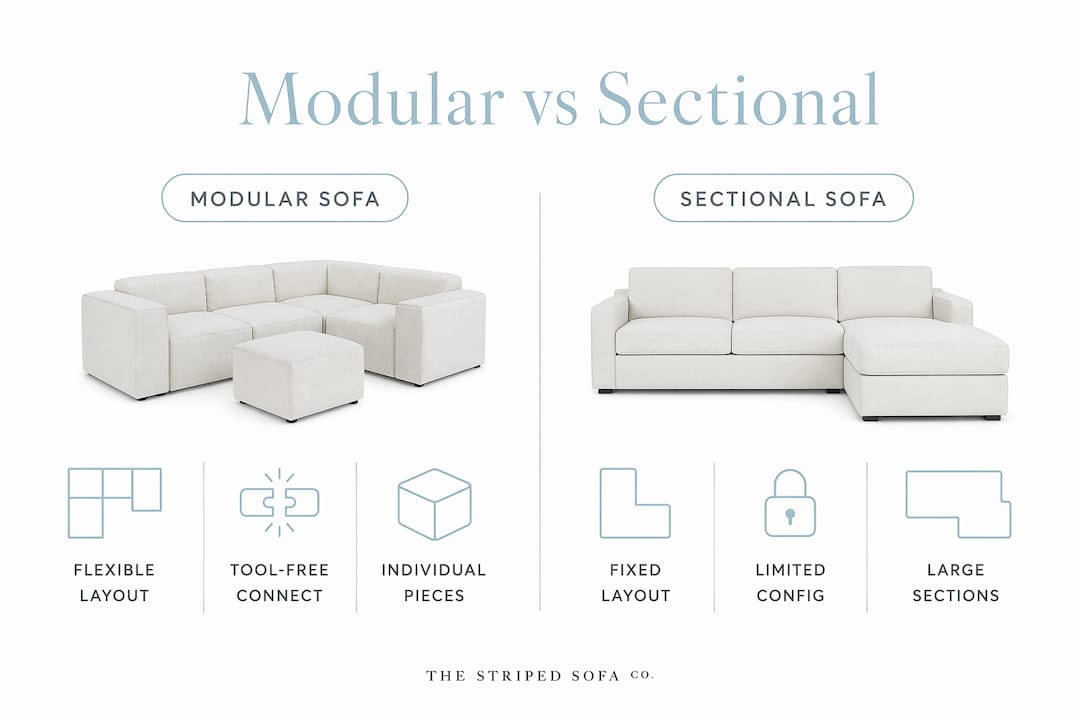
The table below clarifies how modular sofas compare to sectionals and traditional sofas, three furniture types that shoppers frequently confuse.
| Feature | Modular sofa system | Sectional sofa | Traditional sofa |
|---|---|---|---|
| Layout flexibility | Fully reconfigurable | Fixed layout | Fixed layout |
| Transport ease | High (individual pieces) | Moderate (2–3 large pieces) | Low (one large unit) |
| Scalability | Add modules over time | Cannot expand | Cannot expand |
| Independent use of pieces | Yes | No | No |
| Connection hardware | Required | Minimal | None |
How to choose and configure a modular sofa system for your home
Choosing the right modular configuration requires more discipline than most buyers expect. The temptation is to pick the largest, most dramatic shape and work backward. The result is usually a sofa that overwhelms the room.
Follow this sequence instead:
- Measure the room first, not the sofa. Record the length, width, and the location of every door, window, and radiator. Note ceiling height if you plan a high-back configuration.
- Identify your traffic paths. A sofa that blocks the natural path between the kitchen and the back door will frustrate everyone in the household within a week.
- Decide on the primary function. A family TV room needs different depth and arm height than a formal sitting room used for conversation.
- Choose your anchor piece. Most designers start with the corner unit or the chaise and build outward from there.
- Use the sofa to zone the space. Designers recommend treating modular sofas as flexible zoning tools for open plans rather than fixed furniture pieces. A well-placed L-shape can define a living area within a larger open-plan room without a single wall or partition.
- Plan for the future. If you expect your household to grow, choose a system whose modules are still available for purchase in two or three years.
For sofa configuration options in smaller apartments, a two-seat armless chair plus a chaise often delivers more usable seating than a traditional three-seater, because the chaise doubles as a guest bed. In larger family homes, a U-shape around a central coffee table creates a natural gathering point that a straight sofa simply cannot replicate.
Thinking about how to choose sofa dimensions before you commit to a configuration saves significant time and money. A modular system is only as good as the planning behind it.
What factors affect the quality and durability of modular sofa systems?
Quality in a modular sofa system shows up in three places: the frame, the fabric, and the connectors. Weakness in any one of them shortens the life of the entire system.
- Frame construction. Solid hardwood frames, particularly those built from FSC or SFI certified wood, resist racking and warping far better than engineered wood alternatives. A frame that flexes under load will eventually cause the connection points to loosen.
- Connection hardware. Tool-free connectors are preferred to maintain alignment and user convenience during frequent reconfigurations. Hardware that requires a screwdriver every time discourages reconfiguration and defeats the purpose of the system.
- Foam and cushion fill. Soy-based foam holds its shape longer than petroleum-based alternatives and carries a lighter environmental footprint. Cushion density directly affects how the sofa feels after two years of daily use, not just on the showroom floor.
- Performance fabrics. Fabrics designed for family life withstand wear and maintain their appearance on modular sofas over time. Stain-resistant, bleach-cleanable fabrics free from harmful PFAS chemicals are the current standard for households with children or pets.
- Maintenance. Rotate cushions every few months to distribute wear evenly. Vacuum between modules regularly to prevent debris from working into the connection hardware.
The role of sustainable upholstery in a modular system matters more than it does in a traditional sofa, because you are investing in a platform you intend to keep and grow. Cutting corners on fabric or foam undermines the long-term value of the entire concept.
Are modular sofas the same as sectionals?
Modular sofas and sectional sofas look similar in a showroom, but they operate on fundamentally different principles. Modular sofas are collections of blocks designed for easy rearrangement, while sectionals have fixed layouts that cannot be changed without purchasing an entirely new piece. That distinction matters enormously when your living situation changes.
A sectional arrives in two or three large pieces that connect in one predetermined way. You cannot take the left-arm unit and place it on the right, and you cannot add a module two years later. A true modular system, by contrast, lets you reconfigure in minutes without tools, and each piece functions independently as a chair or ottoman when needed.
The perception that modular sofas are harder to assemble or less stable than sectionals is largely unfounded when the connection hardware is well-made. A quality modular system with hidden brackets or interlocking clips holds together as firmly as any fixed sofa under normal household use. The real risk is buying a modular sofa with poor connectors and mistaking the resulting instability for a category-wide flaw.
Key Takeaways
A modular sofa system is the most adaptable seating investment available, combining individual modules, quality connection hardware, and performance fabrics to create furniture that grows with your life.
| Point | Details |
|---|---|
| Core definition | A modular sofa system is individual seating units that connect and reconfigure freely. |
| Transport advantage | Individual modules pass through narrow entryways, reducing damage risk during moves. |
| Connection hardware matters | Hidden brackets or interlocking clips prevent drifting and make reconfiguration tool-free. |
| Quality indicators | Solid hardwood frames, soy-based foam, and PFAS-free performance fabrics signal lasting value. |
| Planning first | Measure your floor plan and traffic paths before choosing a configuration. |
Why I think modularity is the most underrated quality in a sofa
People ask me constantly whether a modular sofa is “worth it,” and my honest answer is that the question misses the point. The real question is whether you expect your life to stay exactly as it is for the next decade. Almost nobody can say yes to that.
I have watched clients move from a one-bedroom apartment to a family home, then reconfigure the same sofa system three times across two different rooms. The sofa did not become a burden. It became part of the story of the house. That kind of longevity is what I mean when I talk about furniture as a quiet foundation.
What I find most interesting is that modularity is still treated as a niche feature rather than a baseline expectation. A sofa is one of the largest purchases most people make for their home. The idea that it should be permanently fixed in one configuration, in one room, for one stage of life, strikes me as a design philosophy that has not caught up with how people actually live.
The sustainability argument reinforces this. Buying one well-made modular system and adding to it over time produces far less waste than replacing a fixed sofa every five to seven years. That is not just good for the household budget. It is a more honest relationship with the objects we bring into our homes.
— Kevin O’Gara
Striped Sofa Co and the art of the adaptable living room
At Striped Sofa Co, the belief that a sofa should serve you for decades, not just seasons, shapes every design decision. Each piece is made to order in 6–8 weeks using FSC and SFI certified wood, soy-based foam, and stain-resistant, bleach-cleanable fabrics free from harmful PFAS chemicals. The result is furniture with the warmth of American craftsmanship and the practicality that modern living demands.
Whether you are furnishing a compact rental or a generous family room, the custom sofa designs at Striped Sofa Co let you choose fabrics, dimensions, and configurations that fit your space and your life. Explore the full collection at Striped Sofa Co and find the sofa that grows with you.
FAQ
What is a modular sofa system, exactly?
A modular sofa system is a seating arrangement made from individual units, such as corner pieces, armless chairs, and chaises, that connect together and can be reconfigured freely. Each module also functions as a standalone piece of furniture.
How does a modular sofa differ from a sectional?
Sectionals have a fixed layout and cannot be rearranged or expanded, while modular sofas allow tool-free reconfiguration in minutes and can grow with additional modules over time.
What connection hardware should I look for?
Look for hidden brackets, alligator clamps, interlocking clips, or Velcro-style fixings. Systems with tool-free connectors maintain alignment better and make reconfiguration far more practical during daily life.
Can a modular sofa work in a small apartment?
A modular sofa works particularly well in small spaces because individual pieces pass through narrow hallways and tight stairwells, and the configuration can be scaled down to fit a compact floor plan precisely.
What fabrics hold up best on a modular sofa?
Performance fabrics that are stain-resistant and bleach-cleanable, and free from PFAS chemicals, offer the best combination of durability and safety for family households. They maintain their appearance through years of regular use.