

Sofa configuration is defined as the shape, size, and structural arrangement of a sofa relative to the room it occupies. Getting it right changes how a room feels, how people move through it, and how long the furniture lasts. The best sofa configuration options are modular and customizable, giving homeowners and renters the power to match their space, lifestyle, and taste without compromise. This guide covers every major configuration type, the customization features that matter most, and the practical measurements that separate a good choice from a great one.
1. Common sofa configuration types and their ideal rooms
Sofa configurations fall into five main categories, each suited to a different room shape and way of living. Knowing which type fits your space is the first decision you make, and it shapes every choice that follows.
L-shaped sectionals work best in rectangular rooms and corners. They create a natural division between living and dining areas without a wall. L-shaped sectionals fit well in rooms where one long wall and one short wall meet, making them the most common choice for open-plan apartments.
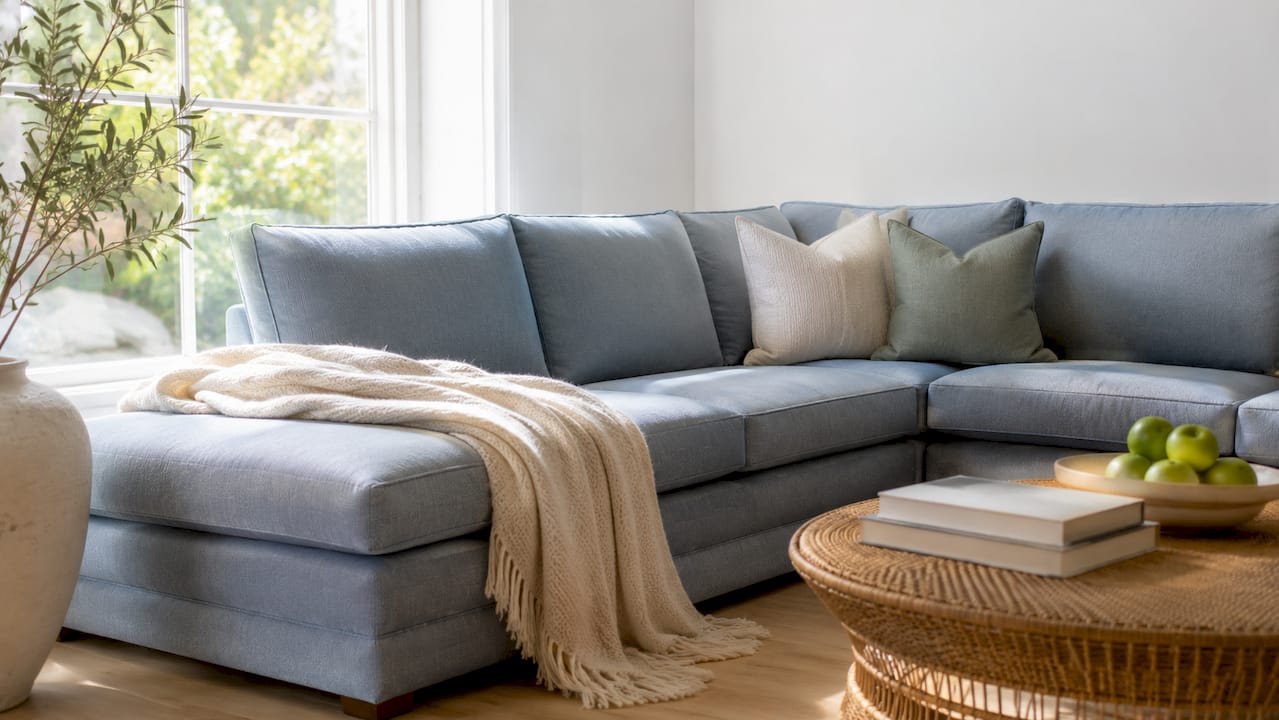
U-shaped sectionals wrap three sides of a seating area and create a true gathering space. They require at least 12x12 feet of room to breathe properly. Rooms under that threshold feel crowded and lose the walkway clearance that makes a space livable.
Sectionals with a chaise offer a middle ground. They seat four to six people comfortably while giving one person a place to stretch out fully. They suit medium rooms where a full U-shape would overpower the space.
Linear sofas are the classic straight sofa, two to four seats wide, placed against a wall or floating in the center of a room. They work in nearly any layout and remain the most flexible option for renters who move often.
Daybed-style sofas blur the line between seating and sleeping. They suit studio apartments and guest rooms where a single piece needs to serve two functions without looking like a compromise.
| Configuration | Typical width | Minimum room size | Best room shape |
|---|---|---|---|
| L-shaped sectional | 100"–130" per side | 12 ft x 10 ft | Rectangular, open plan |
| U-shaped sectional | 110"–140" per side | 12 ft x 12 ft | Square, large open plan |
| Sectional with chaise | 110"–120" total | 11 ft x 13 ft | Rectangular |
| Linear sofa | 72"–108" total | 10 ft x 10 ft | Any |
| Daybed style | 78"–90" total | 9 ft x 10 ft | Studio, guest room |
Rooms under 12 square meters seat two to three modules comfortably. Rooms over 18 square meters can hold five to seven modules without crowding. That range gives you a reliable starting point before you measure a single wall.
2. Customization options: seat depth, back firmness, and frame choices
True customization goes far beyond picking a fabric color. Custom sofas allow selection of frame material, foam density, seat depth, and arm height, each of which changes how the sofa performs over years of daily use.
Seat depth is the single most personal measurement in sofa design. Deeper seats, typically 39"–48", invite you to sink in and stay. Shallower seats keep your posture upright, which suits formal sitting rooms and spaces where guests come and go quickly. Customized fill choices let buyers select seat depths from a standard 39" up to 48" or fully custom dimensions, so the sofa fits the people who actually use it.
Back firmness follows the same logic. Relaxed, pillow-back cushions suit lounging and family rooms. Tight, firm backs suit dining-adjacent seating and rooms where the sofa doubles as a workspace perch. Deeper seats and relaxed cushions serve lounging; shallower seats and firmer backs serve formal entertaining.
Frame material determines how long the sofa lasts, more than any other factor. Kiln-dried hardwood frames last 12–15 years. Lower-quality frames last 3–5 years. The difference in cost is real, but the difference in lifespan makes kiln-dried hardwood the clear value choice for anyone who plans to stay in a home for more than a few years.
- Kiln-dried hardwood: best durability, 12–15 year lifespan
- Engineered wood: mid-range durability, suitable for lighter use
- Softwood or MDF: budget option, best for low-traffic rooms only
- High-density foam (40D–45D HR): firm, long-lasting support for seats used six or more hours daily
- Standard foam: softer feel, shorter lifespan under heavy use
Pro Tip: Order a fabric sample before committing to any upholstery. What looks right on a screen often reads differently in your room’s natural light.
Stain-resistant fabrics deserve their own consideration. High-performance upholstery that is bleach-cleanable and free from PFAS chemicals protects both your investment and your household. Striped Sofa Co builds every sofa with designer-grade performance fabrics that meet this standard without sacrificing the warmth and texture that make a room feel lived-in.
3. Modular sofa features and space planning essentials
Modular sofas are defined by their ability to be reconfigured after purchase. Individual sections connect and disconnect, so the sofa can grow with your household or shrink when you move to a smaller space. That flexibility makes them the best customizable sofa option for renters and homeowners alike in 2026.
The practical benefits are real, but so are the planning requirements. Modular sofas with connector brackets prevent sections from shifting apart over time, creating a stable arrangement that holds its shape through daily use. Without brackets, sections drift and the sofa loses its form within months.
Space planning starts before you buy. Measure doorway diagonal clearance and subtract at least 24 inches from wall length for side-table clearance when planning sofa placement. Delivery day surprises are avoidable with a tape measure and fifteen minutes of preparation.
Measurement checklist before you buy:
- Room length and width at floor level
- Doorway width and diagonal clearance for each section
- Hallway width along the delivery path
- Wall length minus 24" for side-table clearance on each end
- Ceiling height if you are considering high-back configurations
- Standard seat depth of 90–100 cm and walkway clearance of at least 70–80 cm around the sofa
Pro Tip: Tape the sofa’s footprint on your floor with painter’s tape before ordering. Walk around it for a day. You will know immediately if the scale is right.
Modular sofas with armless pieces offer the most flexibility for high-traffic households. Armless sections pack tighter, seat more people, and reconfigure faster than armed sections. The trade-off is that armless arrangements can feel less defined, so pairing them with a strong fabric pattern or a bold color grounds the composition visually.
4. How to choose the best sofa configuration for your space and lifestyle
The right configuration matches three things at once: your room’s geometry, your household’s habits, and your tolerance for maintenance. Getting all three right is what separates a sofa you love from one you quietly resent.
Match configuration to room geometry first. A long, narrow room calls for a linear sofa or a shallow L-shape. A square room with no dominant wall suits a U-shape or a floating sectional with a chaise. When in doubt, the L-shape is the most forgiving configuration across room types.
Consider how your household actually uses the space. Families with young children need stain-resistant fabrics for high-traffic homes and configurations that allow easy cleaning access around and under every section. Entertainers need seating that faces inward, which points toward U-shapes and sectionals with chaises. Solo dwellers and couples often find a well-chosen linear sofa with a deep seat more satisfying than a large sectional that dominates the room.
Renters need adaptability above all else. A modular sofa that breaks into sections under 80" wide fits through most standard doorways and adapts to the next apartment’s layout. Choosing sofa styles with clean lines and neutral or classic patterns also protects resale value if circumstances change.
Here are four scenarios that illustrate how configuration choices play out in practice:
- Studio apartment, 400 sq ft: A linear 84" sofa with a daybed-style chaise on one end seats two guests and converts to a sleeping surface. Fabric choice matters most here since the sofa is always visible.
- Open-plan family home, 600 sq ft living area: An L-shaped sectional with five modules defines the seating zone without blocking sightlines to the kitchen. Connector brackets keep sections aligned through daily family use.
- Formal living room, 14 ft x 16 ft: A pair of linear sofas facing each other with a coffee table between them creates symmetry and encourages conversation. This arrangement suits rooms where the sofa is more for guests than for nightly lounging.
- Rental apartment, 350 sq ft: Two armless modular sections plus one corner piece give the flexibility of an L-shape today and a linear arrangement in the next home. The sofa back height stays low to keep the room feeling open.
Key Takeaways
The most effective sofa configuration matches room geometry, household habits, and fabric durability to create a piece that serves the home for a decade or more.
| Point | Details |
|---|---|
| Match shape to room size | L-shapes suit rectangular rooms; U-shapes need at least 12x12 feet of clear space. |
| Prioritize frame material | Kiln-dried hardwood frames last 12–15 years; lower-quality frames last 3–5 years. |
| Measure before you order | Subtract 24" from wall length for side tables and check doorway diagonal clearance. |
| Choose fabric for your lifestyle | High-traffic homes need stain-resistant, bleach-cleanable upholstery free from PFAS chemicals. |
| Modular means adaptable | Connector brackets prevent section drift; armless pieces offer the most reconfiguration flexibility. |
Why configuration is the decision most people get wrong
People spend hours choosing fabric and almost no time thinking about configuration. I have seen it happen in my own circle of friends and in the homes of clients who reach out to Striped Sofa Co after a purchase they regret. The sofa arrives, it looks beautiful, and then they realize the walkway is too narrow or the chaise faces the wrong wall.
The honest truth is that configuration is a spatial problem before it is a style problem. You solve it with a tape measure, not a mood board. Once the geometry is right, the style choices become genuinely enjoyable because you are working within a frame that fits.
What I find most interesting about the current moment in furniture is that renters are finally being taken seriously as buyers. The rise of modular sofas with armless pieces and connector systems reflects a real shift in how people live. Fewer people stay in one home for twenty years. A sofa that adapts to three apartments over a decade is not a compromise. It is the wiser investment.
My advice is to buy the best frame and fabric you can afford, then let the configuration follow from the room. A kiln-dried hardwood frame with high-density foam and a performance fabric will outlast two or three cheaper sofas. The cost per year of ownership tells a very different story than the sticker price.
— Kevin O’Gara
Striped Sofa Co: sofas built to fit your life
Striped Sofa Co makes every sofa to order in 6–8 weeks using FSC and SFI certified wood, soy-based foam, and stain-resistant, bleach-cleanable fabrics free from PFAS chemicals. Each piece is made in America and built to the specifications you choose, from seat depth and back firmness to the fabric that ties your room together.
Whether you are drawn to the classic lines of The Dalston or want to build a configuration from scratch, the custom sofa design process at Striped Sofa Co walks you through every decision. You can also browse the full collection at stripedsofaco.com to find the configuration and fabric that fits your space and the way you actually live in it.
FAQ
What is the most versatile sofa configuration for small spaces?
A linear sofa between 72" and 84" wide is the most versatile option for small spaces. It fits through standard doorways, works against any wall, and leaves enough clearance for comfortable movement around the room.
How do I choose sofa configuration for an open-plan layout?
An L-shaped sectional defines a seating zone in an open-plan room without blocking sightlines. Place the longer arm parallel to the main traffic path to keep walkways clear.
What seat depth works best for everyday lounging?
A seat depth of 39"–48" suits everyday lounging, with deeper seats feeling more relaxed. Shallower seats and firmer backs work better for formal or upright seating needs.
Why do modular sofas shift apart over time?
Modular sections shift when they lack connector brackets between pieces. Brackets lock sections together and maintain the configuration’s shape through daily use.
What fabric type is best for a high-traffic sofa?
Stain-resistant, bleach-cleanable performance fabrics are the best choice for high-traffic sofas. They resist spills, clean easily, and hold their appearance far longer than standard upholstery under heavy daily use.