

The order made-to-order sofa workflow is the structured process that transforms your design choices into a handcrafted sofa built precisely for your home. In the furniture industry, this process is formally called a configure-to-order or bespoke production workflow. It integrates customer configuration, bill of materials (BOM) generation, material procurement, and quality inspection into a single coordinated sequence. Striped Sofa Co completes this process in 6–8 weeks using FSC and SFI certified wood, soy-based foam, and PFAS-free performance fabrics. Understanding each stage before you place an order saves time, prevents costly mistakes, and gives you a sofa that feels like it was made for the life you actually live.
What do you need before starting the custom sofa order workflow?
A successful custom sofa ordering process begins with preparation, not guesswork. Arriving at the configuration stage without the right measurements, material preferences, and documentation leads to delays and revisions that push your delivery date back by weeks.
The information you need to gather first
Before you configure anything, collect these essentials:
- Room dimensions and sofa footprint: Measure the wall length, ceiling height, and any doorways the sofa must pass through during delivery.
- Fabric and finish preferences: Identify your preferred upholstery category, such as performance weave, velvet, or linen blend, and note any color or pattern direction.
- Hardware and leg finish: Decide on leg material (wood, metal, or lacquered) and finish tone to match existing furniture.
- Lifestyle requirements: Note whether you need stain resistance, pet-friendly durability, or bleach-cleanable fabric. These choices affect which materials qualify.
- Budget range: Custom sofas vary widely in price based on frame complexity, fabric grade, and production location.
Pro Tip: Request fabric samples before finalizing your order. Fabric colors shift under different lighting conditions, and a sample held in your actual room tells you far more than a screen image ever will.
Sourcing sustainable materials: what the standards mean
Sustainable sourcing is no longer a niche preference. Clients increasingly seek made-to-order sofas with performance fabrics and sustainability promises. FSC (Forest Stewardship Council) and SFI (Sustainable Forestry Initiative) certifications on frame wood confirm responsible harvesting. Soy-based foam replaces petroleum-derived foam and reduces off-gassing in your home. PFAS-free fabric treatments deliver stain resistance without the chemical residue linked to health concerns.
| Material | Standard or Certification | Why It Matters |
|---|---|---|
| Frame wood | FSC or SFI certified | Confirms responsible forest sourcing |
| Cushion fill | Soy-based foam | Reduces petroleum use and off-gassing |
| Upholstery fabric | PFAS-free treatment | Stain resistance without harmful chemicals |
| Fabric performance | Bleach-cleanable rating | Practical for families and high-traffic rooms |
Documentation matters as much as the materials themselves. A proper bill of materials lists every component, its source, and its specification. Factories that skip this step rely on handwritten notes, which leads to frequent errors and delays in production.
How does the order made-to-order sofa workflow progress step by step?
The bespoke sofa workflow moves through six distinct stages. Each stage feeds directly into the next, so a gap or error at any point compounds downstream.
Step 1: Design selection and configuration
You choose the sofa model, dimensions, fabric, leg finish, and any structural options such as cushion count or arm style. A 3D visual configurator lets you see the combination before committing. A hybrid approach combining customer-facing 3D tools with a backend production system improves both accuracy and the overall experience. The frontend makes customization feel natural. The backend translates those choices into production language without manual re-entry.

Step 2: Automated BOM and routing generation
Once your configuration is confirmed, a sophisticated workflow automatically generates the production BOM and routing instructions. This eliminates the spreadsheet-and-handwritten-note approach that causes so many errors in smaller operations. Every component, from the corner blocks to the welt cord, appears in a structured document that the factory floor receives digitally.
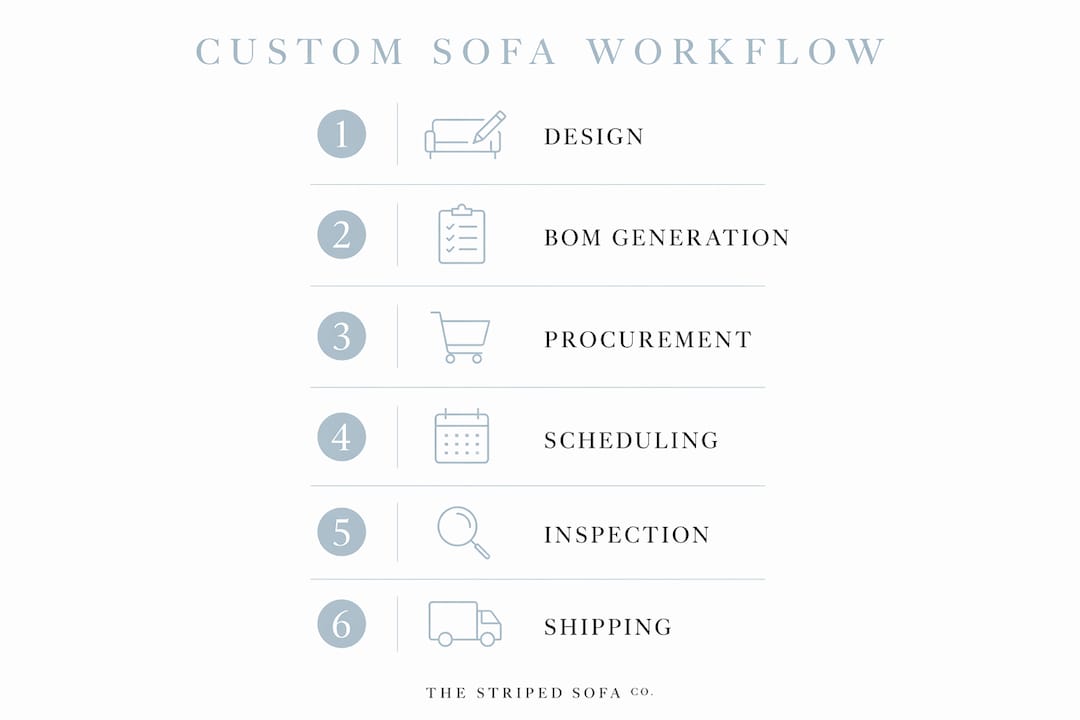
Step 3: Material procurement over a lead-time pipeline
Procurement teams consolidate material needs across all active orders rather than ordering job by job. Seeing material needs over a 4–8 week horizon reduces rush purchases and keeps fabric and foam inventory aligned with the production schedule. This is where your fabric choice directly affects your timeline. A fabric held in stock ships to the factory within days. A special-order fabric adds 2–3 weeks to the front of your lead time.
Step 4: Production scheduling adjusted for complexity
Not all sofas take the same time to build. A simple custom shelf takes two days, whereas a fully upholstered bespoke sofa with client-specified fabric and a curved frame takes three weeks. Scheduling logic must account for the extra labor and specialized skills that complex pieces require. A hand-stitched curved sofa, for example, cannot share a production slot with a straight-arm bench model without adjustment.
Step 5: Quality inspection and finishing
Before packaging, every sofa passes through a staged inspection. The process includes technical review, pre-production sign-off, and a pre-shipment inspection to catch any quality issues before the piece leaves the factory. Finishing touches, such as button tufting alignment, welt cord tension, and leg attachment, receive individual attention at this stage.
Step 6: Packaging, shipping, and delivery
White-glove delivery services carry the sofa into your room, position it, and remove all packaging. This final stage matters more than most families expect. A sofa damaged in transit because of inadequate packaging undoes every careful decision made in the previous five steps. Custom sofas typically take 8–12 weeks from order to delivery in workflows that integrate modern production tools. Striped Sofa Co delivers within 6–8 weeks, which sits at the faster end of that range.
Pro Tip: Confirm your delivery address and stairwell clearance with the delivery team before your ship date. A sofa that cannot fit through a doorway requires disassembly or return, both of which add weeks to your timeline.
What role does technology play in the made-to-order sofa process?
Technology is the connective tissue of a well-run custom sofa production process. Without it, each stage operates in isolation and errors multiply at every handoff.
The most effective setup combines a customer-facing 3D configurator with a backend CPQ (configure, price, quote) or ERP (enterprise resource planning) system. A hybrid product configuration system is the defining feature of modern made-to-order furniture success. The configurator handles the customer experience. The ERP handles pricing, BOM generation, procurement triggers, and production scheduling automatically.
Key technology functions in a mature workflow include:
- Automatic pricing and quoting: The system calculates the price the moment you finalize your configuration, with no manual quote required.
- Production BOM generation: Every component populates a structured list that routes to the correct workstation.
- Scheduling logic for complexity: The system assigns longer production windows to bespoke pieces with curved frames or hand-stitched details.
- AI and OCR for document management: AI and OCR tools automate supplier order generation and document reading, saving several hours of admin work each week for mid-sized manufacturers.
- Order tracking and communication: Customers receive status updates at each stage, which reduces inbound inquiries and builds trust.
“The most successful made-to-order businesses employ a hybrid method integrating user-friendly frontend design tools with backend production automation.” — Product Configuration Engine research
This integration removes the single biggest source of error in custom furniture: the gap between what the customer chose and what the factory received.
How do you troubleshoot common mistakes in the custom sofa ordering process?
Most delays and quality problems in the tailored sofa design process trace back to a small set of recurring errors. Knowing them in advance lets you avoid them entirely.
Common mistakes and how to prevent them:
- Miscommunication between customer and factory: Prevent this with a confirmed written specification document that both parties sign before production begins.
- Improper material selection: Choosing a fabric rated for light residential use in a high-traffic family room leads to premature wear. Match the fabric’s durability rating to your actual usage.
- Underestimated production time: Complex pieces with curved frames or hand-stitched details require special scheduling logic that accounts for extra resources and time. Ask your manufacturer how they handle scheduling for bespoke complexity before you commit.
- BOM errors caught too late: A missing component discovered mid-production halts the entire job. Review the BOM with your manufacturer before production starts.
- Skipping sample rounds: The staged approval process, including fabric samples and pre-production sign-off, exists to catch problems before they become expensive. Never skip a sample round to save time.
Pro Tip: Ask your manufacturer to confirm the fabric dye lot before production begins. Dye lots vary between batches, and a sofa with mismatched cushion fabric and body fabric is a quality failure that is difficult to correct after the fact.
Patience and staged approvals are not bureaucratic friction. They are the mechanism that delivers the sofa you actually imagined.
Key takeaways
The order made-to-order sofa workflow succeeds when design configuration, automated BOM generation, sustainable material sourcing, and staged quality approvals work together as one coordinated process.
| Point | Details |
|---|---|
| Prepare before configuring | Gather room dimensions, fabric samples, and lifestyle requirements before starting your order. |
| Automation reduces errors | Automated BOM and routing generation eliminates the handwritten-note errors that delay production. |
| Complexity affects timeline | Hand-stitched or curved sofas require longer production windows than standard configurations. |
| Staged approvals protect quality | Pre-production sign-off and pre-shipment inspection catch problems before they reach your home. |
| Sustainable materials are available | FSC-certified wood, soy-based foam, and PFAS-free fabrics are standard options, not premium add-ons. |
Why the workflow matters more than the sofa itself
I have spent years thinking about what makes a custom sofa worth the wait. The honest answer is that the workflow is the product. A sofa built through a disciplined process, with confirmed specifications, staged approvals, and honest lead times, arrives feeling like it was made for you. Because it was.
What I see most often go wrong is impatience at the front end. Families rush through the configuration stage, skip the fabric sample, and then feel surprised when the color reads differently in their living room than it did on a screen. The workflow exists to slow you down at exactly the right moments. A 3D configurator is not just a sales tool. It is a decision checkpoint. Use it seriously.
Technology has genuinely changed what is possible in this process. The shift from spreadsheets and handwritten factory notes to integrated ERP and AI-assisted procurement is not a small improvement. It is the difference between a workflow that works and one that hopes. I believe every family deserves to know what stage their sofa is in, what materials are going into it, and why the timeline is what it is. Transparency is not a feature. It is the baseline.
My strongest advice: choose a manufacturer whose sustainability commitments are documented, not just marketed. FSC-certified frames and PFAS-free fabrics are not talking points. They are choices that affect the air quality in your home and the longevity of the piece you are investing in. A sofa that lasts twenty years is the most sustainable sofa you can buy.
— Kevin O’Gara
Striped Sofa Co and the custom sofa you have been imagining
Striped Sofa Co builds luxury performance striped sofas in America using FSC and SFI certified wood, soy-based foam, and stain-resistant, bleach-cleanable fabrics free from PFAS chemicals. Every piece is made to order and delivered within 6–8 weeks.
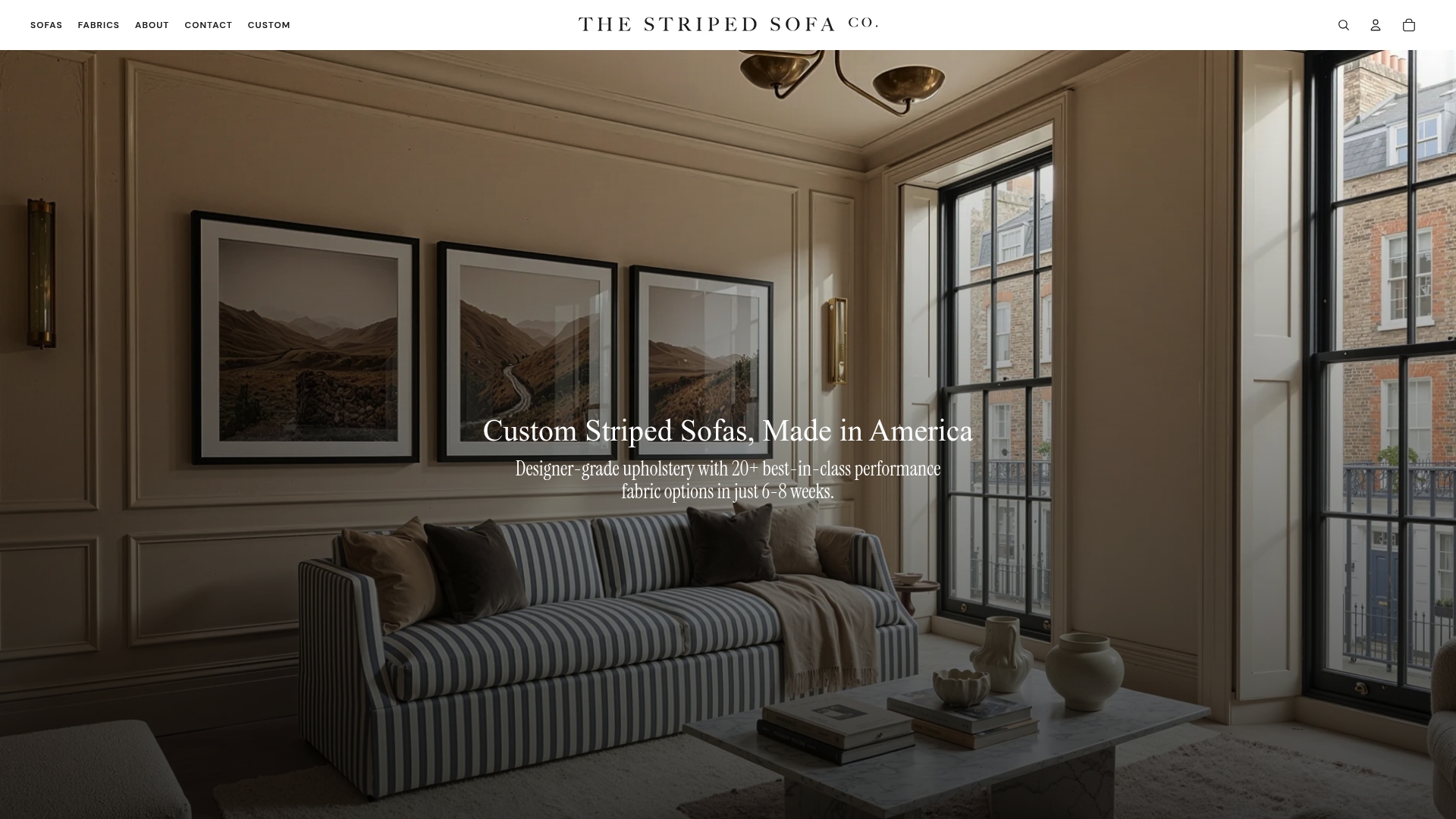
The custom sofa design tool lets you configure your sofa with the same precision the workflow demands, choosing fabric, silhouette, and finish with a clear view of the result. If you are ready to see what a well-made, thoughtfully sourced sofa looks like in your home, Striped Sofa Co is where that process begins. You can also explore performance fabric samples before committing to a full order.
FAQ
What is the order made-to-order sofa workflow?
The order made-to-order sofa workflow is the end-to-end process that moves a custom sofa from customer design configuration through BOM generation, material procurement, production, quality inspection, and delivery. It is also called a configure-to-order or bespoke production workflow in the furniture industry.
How long does a custom sofa take to arrive?
Custom sofas typically take 8–12 weeks from order to delivery in workflows using modern production tools. Striped Sofa Co completes the process in 6–8 weeks.
What materials should I look for in a sustainable custom sofa?
Look for FSC or SFI certified frame wood, soy-based foam cushion fill, and upholstery fabric with a PFAS-free stain-resistant treatment. These three material choices cover the frame, fill, and surface durability of a well-built sofa.
Why do complex sofas take longer to produce?
A fully upholstered bespoke sofa with a curved frame and hand-stitched details requires specialized labor and longer production scheduling than a standard straight-arm model. Scheduling logic must account for the extra resources and time that bespoke complexity demands.
What is a bill of materials in sofa production?
A bill of materials, or BOM, is a structured document listing every component in a sofa, from corner blocks to welt cord, along with its source and specification. Automated BOM generation eliminates the manual errors that occur when factories work from handwritten notes or spreadsheets.