

Upholstery construction methods refer to the systematic layering of materials and techniques that build the structure, comfort, and appearance of upholstered furniture. Every sofa, armchair, or settee you sit on is the product of six distinct layers working in concert, from the wooden frame at its core to the cover fabric stretched across its surface. Understanding how those layers interact is the difference between furniture that holds its shape for decades and a piece that sags within a few years. Whether you are restoring a Victorian armchair or specifying a new custom sofa, knowing the anatomy beneath the fabric gives you real authority over the outcome.
What are the essential layers in upholstery construction?
Upholstery construction is a series of functional layers where failures in any lower layer cause visible problems in comfort and appearance. That single principle explains almost every upholstery complaint you will ever encounter. A wrinkled cover fabric is rarely a fabric problem. It is almost always a padding or spring problem showing through.
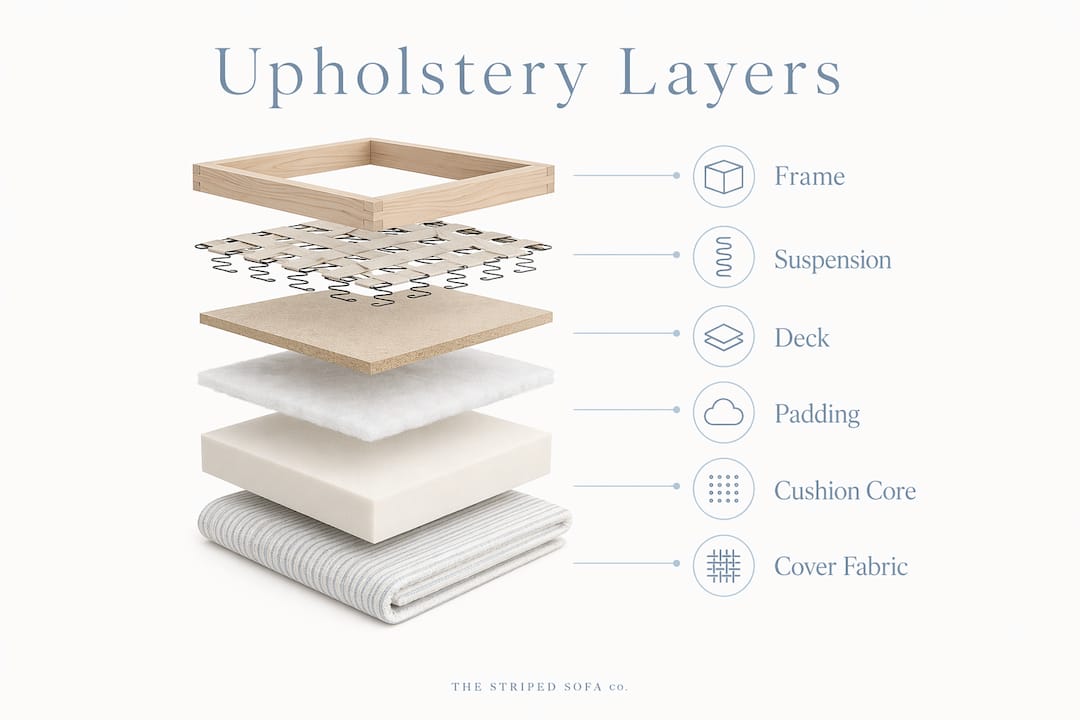
The six layers, in sequence from bottom to top, are:
- Frame: Hardwood or engineered wood forms the skeleton. Kiln-dried hardwoods like beech and ash resist warping and hold tacks reliably over time.
- Suspension: Jute webbing, coil springs, or sinuous wire springs carry the load. This layer determines how weight is distributed across the seat.
- Deck/platform: A layer of heavy burlap or platform cloth covers the suspension and creates a stable base for padding.
- Padding and edge build-up: Coir fiber, horsehair, cotton batting, or foam shapes the contours and provides resilience.
- Cushion core and wrap: Loose cushions use foam, feather, or a combination wrapped in batting to achieve the desired softness and crown.
- Cover and seams: The outer fabric controls final tension and visual finish. It cannot create structure by itself.
Traditional upholstery materials interact as a system where foundation, support, padding, and surface layers cooperate to achieve durability and comfort. Remove or compromise one layer, and the whole system degrades. A broken spring creates uneven support that no amount of new padding can correct. Loose burlap lets stuffing migrate, producing lumps the cover fabric makes visible.
| Layer | Common materials | Primary function |
|---|---|---|
| Frame | Beech, ash, engineered wood | Structural skeleton and tack rail |
| Suspension | Jute webbing, coil springs, sinuous springs | Load distribution and bounce |
| Deck/platform | Heavy burlap, platform cloth | Base for padding layers |
| Padding | Coir fiber, horsehair, cotton felt, foam | Shape, volume, and resilience |
| Cushion core | Foam, feather, fiber wrap | Seat softness and crown |
| Cover | Woven fabric, leather, performance cloth | Tension, appearance, and wear surface |
How do traditional upholstery techniques compare to modern methods?
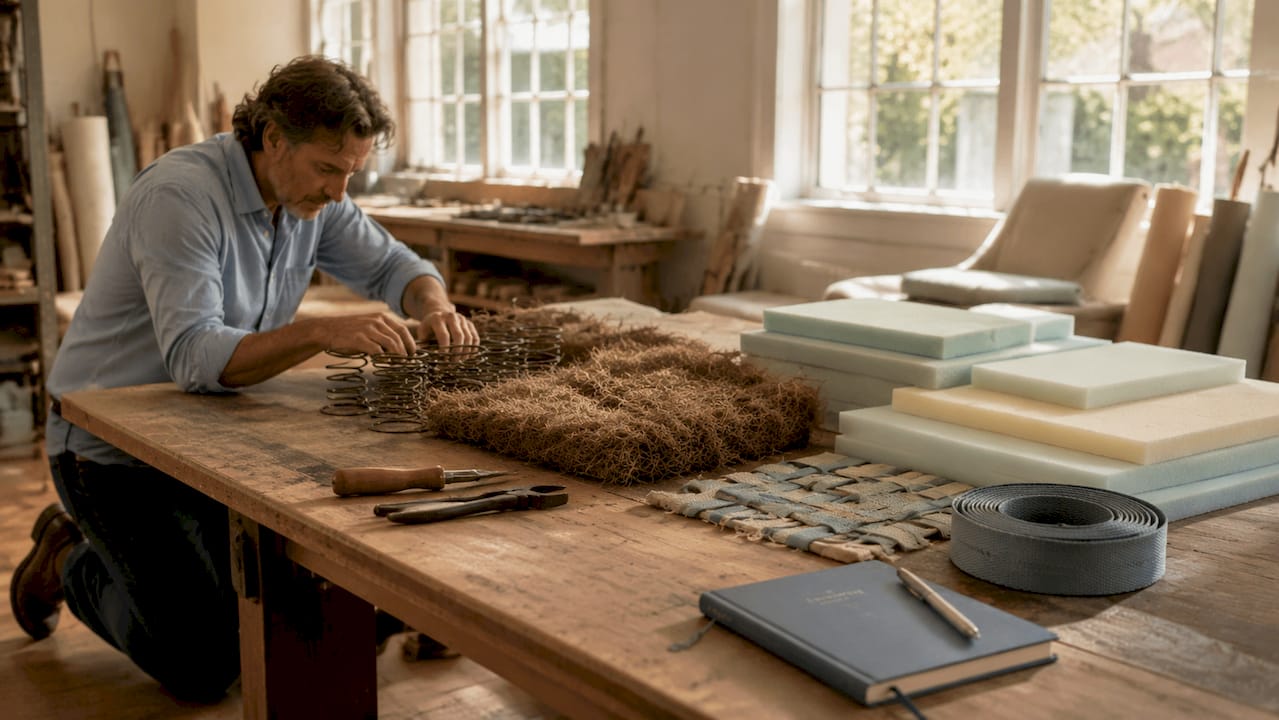
Traditional and modern furniture upholstery methods differ most in how they build the suspension and padding layers. Traditional hand-crafted upholstery uses individually hand-sewn coil springs, natural fiber padding, and hand-stitched edge rolls. Modern assembly methods substitute pre-made spring units, sinuous wire springs, and synthetic foam to reduce labor time and cost.
| Characteristic | Traditional methods | Modern methods |
|---|---|---|
| Suspension | Hand-tied coil springs on jute webbing | Sinuous springs or pre-made spring units |
| Padding | Coir, horsehair, cotton felt in layers | Polyurethane or soy-based foam |
| Edge definition | Hand-stitched rolls | Pre-formed foam edges |
| Repairability | High, layer by layer | Moderate, often unit replacement |
| Cost and time | Higher cost, longer build | Lower cost, faster production |
| Best suited for | Restoration, heirloom pieces | New production, performance furniture |
Traditional methods produce furniture with exceptional repairability. Each layer can be replaced independently without disturbing the others. Modern methods deliver consistency and speed, which matters when a custom sofa needs to be ready in 6–8 weeks without sacrificing structural integrity.
Pro Tip: When restoring a piece built before 1960, always match the original construction method. Substituting foam for horsehair changes the seat profile and can distort the cover fabric’s fit, especially on curved or tufted work.
The best upholstery construction practices combine both worlds. A frame built with FSC-certified hardwood, a suspension using quality sinuous springs, and a padding layer of soy-based foam can deliver the longevity of traditional work with the performance benefits of modern materials. Striped Sofa Co. builds every sofa on exactly this principle, using American-made sustainable construction that honors the craft without being bound to its slowest methods.
What is the professional upholstery workflow from teardown to cover fitting?
Professional upholstery workflow follows the sequence: intake, inspection, teardown, build-up, cover fitting, and final inspection. Each step has decision gates that protect both the craftsperson and the client. Skipping a gate is how costly mistakes happen.
The workflow in practice looks like this:
- Intake and inspection: Assess the frame for wobble, broken joints, and damaged tack rails. Identify the construction type before quoting.
- Teardown as evidence gathering: Restoration teardown manages a memory window where layer order, tack lines, stuffing sequence, and wood marks must be recorded before removal. Photograph every layer before pulling it.
- Frame correction: Reglue loose joints, replace broken rails, and re-tighten corner blocks before any new material goes on.
- Suspension rebuild: Replace broken springs or webbing. Re-tie coil springs to their original height and tension pattern.
- Deck and padding build-up: Lay burlap over the suspension, then build padding layers in sequence from coarse to fine. Shape edge rolls before adding surface padding.
- Cushion preparation: Cut and wrap foam cores, or re-stuff feather cushions, before the cover goes on.
- Cover fitting: Dry-fit the cover to check tension and alignment before final tacking. The cover is a finishing system, not a structural fix.
- Final inspection: Check all seams, tack lines, and surface tension under good light before delivery.
Pro Tip: Experienced upholsterers dry-fit covers only after correcting every structural and padding layer. Pulling a cover tight over a problem does not solve the problem. It makes the problem permanent.
Professional upholstery projects are highly decision-driven with defined checkpoints that make scope changes traceable. That discipline is what separates a piece that lasts 30 years from one that returns for repairs in three.
How do coil springs, twine, and webbing work together?
The spring suspension system is the most technically demanding part of furniture upholstery methods, and the most commonly misunderstood. Jute webbing carries the springs, while twine controls spring movement multidirectionally to maintain seat profile and comfort. Webbing that sags or tears will cause the entire seat to collapse, regardless of how well the springs are tied.
Here is how the system works in sequence:
- Jute webbing is interlaced across the seat frame and tacked under tension, forming a flexible but firm base.
- Coil springs are hand-sewn individually to the webbing intersections using a curved needle and laid cord.
- Spring tying uses a grid pattern where crossing twine compresses springs to a consistent height for balanced support.
- Twine runs in four directions: front to back, side to side, and both diagonals. Each direction controls a different axis of spring movement.
- A layer of heavy jute burlap is then stitched over the spring tops to hold them in position and create the deck surface.
Twine patterns and knots precisely control forward, backward, diagonal, and sideways spring movements, shaping user comfort and seat profile under load. A spring tied only front to back will rock sideways under a shifting occupant. That lateral movement eventually distorts the seat shape and wears the cover fabric unevenly.
Pro Tip: When inspecting a used sofa, press firmly on each corner of the seat. Uneven resistance reveals broken twine or failed webbing, not just worn padding. That distinction changes the repair scope entirely.
What padding materials shape upholstery comfort and profile?
Padding is where the furniture’s personality takes form. Padding layering starts with coir fiber for volume, horsehair for resilience, and cotton felt or skin wadding for smoothing, using stitching and twine for edge rolls. Each material performs a specific job, and the sequence matters as much as the materials themselves.
Common stuffing layers and their roles:
- Coir fiber: Coarse coconut fiber provides the initial volume and firmness. It is the workhorse layer that sets the seat’s basic height and density.
- Horsehair: Finer and more resilient than coir, horsehair refines the surface and adds spring-back. It is the traditional choice for high-quality seat pads and back cushions.
- Cotton felt and skin wadding: These fine layers smooth out irregularities before the cover goes on. They prevent coarser fibers from telegraphing through to the fabric surface.
- Polyurethane or soy-based foam: Modern builds often replace the coir and horsehair stack with a single foam unit. Soy-based foam, used by Striped Sofa Co., offers comparable resilience with a lower environmental footprint.
- Stitched edge rolls: Twine and a mattress needle stitch the edge padding into a firm, defined roll that holds the seat’s profile under repeated use.
Natural padding materials like horsehair and coir breathe well and compress gradually over decades. Synthetic foams deliver consistent density from day one but can fatigue faster if the foam grade is too low. The Pimlico sofa by Striped Sofa Co. reflects this balance, using carefully chosen materials to achieve the full, rounded profile of a classic English roll arm without sacrificing modern performance.
Key Takeaways
Upholstery construction is a layered system where every material from the frame to the cover fabric performs a specific structural role, and no surface layer can compensate for a failed foundation beneath it.
| Point | Details |
|---|---|
| Layer sequence is non-negotiable | Each of the six layers must be correct before the next is applied. |
| Teardown is an inspection phase | Document layer order, tack lines, and stuffing sequence before removing anything. |
| Spring tying controls seat profile | Twine runs in four directions to manage spring movement under load. |
| Padding sequence shapes the final form | Start with coir for volume, horsehair for resilience, then cotton felt to smooth. |
| Cover fabric is a finishing system | It controls tension and appearance but cannot fix structural or padding failures below. |
Why the foundation always tells the truth
I have spent years thinking about what makes a sofa worth keeping. The honest answer is almost never the fabric. Fabric is the first thing people see and the last thing that actually fails. What fails first is always underneath: a spring that loses its tie, a webbing strand that gives way, a padding layer that was never dense enough to begin with.
The most common mistake I see, even among experienced designers, is treating the cover as the solution. A beautiful fabric pulled tight over a compromised foundation will show every flaw within a year. Wrinkles appear at the front edge. The seat develops a hollow. The back cushions start to lean. None of that is a fabric problem.
Diagnosing which layer causes symptoms like wrinkles, sagging, or hardness is the real skill in this craft. It requires you to read the furniture the way a doctor reads symptoms, mapping what you see on the surface to what is failing below. That diagnostic mindset is what I try to bring to every piece we design at Striped Sofa Co.
The other thing I believe deeply is that teardown is sacred. When you pull apart an old piece, you are reading a craftsperson’s decisions from 50 or 100 years ago. The tack lines, the stuffing density, the spring heights all tell you something. Photograph everything. That memory window closes the moment you pull the first layer, and once it is gone, you cannot get it back.
— Kevin O’Gara
Custom sofas built on every layer, not just the surface
At Striped Sofa Co., the construction philosophy starts at the frame, not the fabric. Every sofa is made to order in America using FSC and SFI certified hardwood, soy-based foam, and performance striped fabrics that are stain-resistant, bleach-cleanable, and free from PFAS chemicals.

The result is furniture that earns its place in a room for decades, not just a season. If you want to see what expert upholstery construction looks like from the outside in, the Dalston bench sofa and the full collection at Striped Sofa Co. show what happens when every layer is done right. Each piece ships in 6–8 weeks, made exactly to your specifications.
FAQ
What are the main layers in upholstered furniture?
The six main layers are the frame, suspension, deck, padding, cushion core, and cover fabric. Each layer performs a specific structural or comfort function, and failures in lower layers always affect the layers above.
How long does quality upholstery construction last?
Well-built upholstery using hardwood frames, properly tied coil springs, and quality padding can last 20–30 years or more with normal use. The suspension and padding layers typically determine longevity more than the cover fabric.
What is the difference between traditional and modern upholstery methods?
Traditional methods use hand-tied coil springs, natural fiber padding like horsehair and coir, and hand-stitched edge rolls. Modern methods use sinuous springs and foam, which reduce build time while still delivering reliable comfort and durability.
Why does my sofa sag even after reupholstering?
Sagging after reupholstering almost always means the suspension layer was not addressed. New cover fabric and padding cannot correct broken springs or failed webbing beneath them.
What is spring tying and why does it matter?
Spring tying is the process of connecting coil springs with twine in a grid pattern to control their movement under load. Proper tying in four directions keeps the seat profile even and prevents the springs from shifting sideways over time.