

Performance fabrics are upholstery textiles engineered to resist stains, tolerate heavy use, and clean up easily through inherent fiber properties or applied finishing treatments. They are the default choice for high-traffic furniture in homes with children, pets, and daily wear. The industry term you will encounter most often is “technical upholstery textile,” but “performance fabric” has become the standard shorthand across interior design and retail. Understanding what performance fabrics are, how they work, and which types suit your home gives you a real advantage when choosing furniture that lasts.
What are performance fabrics, and how do they differ from traditional upholstery?
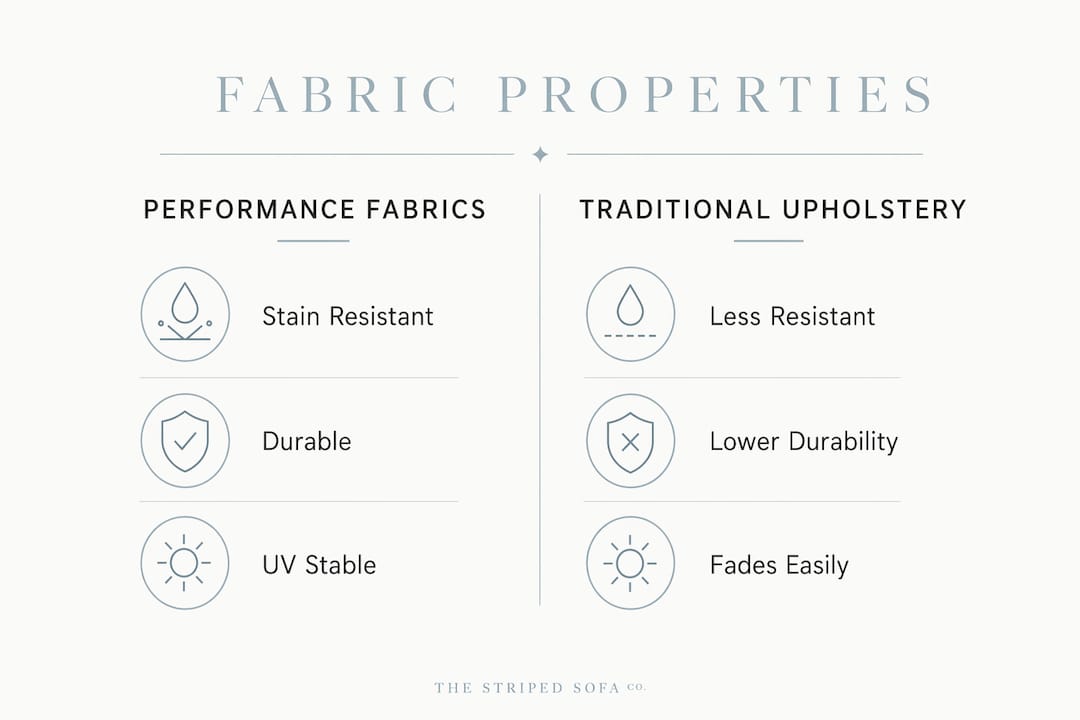
Performance fabrics are defined by measurable functional properties, not just appearance. A traditional linen or cotton weave may look beautiful, but it absorbs spills, fades in sunlight, and wears thin under daily use. A performance textile is engineered to resist stains and tolerate heavy use through fiber selection, weave construction, and finishing treatments working together.
The most important distinction is where the performance lives. Some fabrics earn their durability from the fiber itself. Olefin, for example, is a synthetic fiber with inherent stain resistance because its molecular structure repels liquid at the source. Other fabrics rely on a durable applied finish, a chemical treatment bonded to the surface after weaving. Applied finishes can wear off over time. Fiber-level performance does not.
Traditional upholstery fabrics also lack standardized testing behind their claims. Performance textiles are validated against industry protocols covering moisture-wicking, UV protection, and abrasion resistance. The American Association of Textile Chemists and Colorists sets widely used test methods that manufacturers reference when certifying fabric durability. That testing is what separates a genuine performance textile from a marketing claim.
Pro Tip: Ask any fabric supplier for the specific test results behind their durability claims. A reputable manufacturer will provide lab data, not just a product description.
Key performance properties compared
| Property | Performance fabric | Traditional upholstery |
|---|---|---|
| Stain resistance | Inherent or treated fiber-level repellency | Absorbs spills without treatment |
| Abrasion tolerance | Rated in double rubs (often 30,000+) | Varies widely, often untested |
| UV resistance | Engineered to resist fading | Fades with prolonged sun exposure |
| Moisture management | Wicks or repels moisture | Retains moisture, risks mildew |
| Cleaning method | Soap and water, often bleach-safe | Dry clean or spot treat only |
What types of performance fabrics work best for home furnishings?
Performance fabrics originated in athletic wear and expanded into home furnishings as consumers demanded the same durability indoors. The fiber content and weave structure determine which properties a fabric delivers, and each fiber type involves trade-offs.
Olefin (polypropylene) is the workhorse of performance upholstery. It resists stains at the fiber level, dries quickly, and holds color well under UV exposure. Striped Sofa Co uses olefin-based performance fabrics precisely because the stain resistance is built into the fiber, not applied as a coating that degrades. Olefin does have a lower melting point than nylon, so it requires care around direct heat sources.
Polyester and polyester blends offer excellent abrasion resistance and color retention. They accept a wide range of dye methods, which makes them popular for patterned upholstery. High-denier polyester weaves can achieve double-rub counts that rival commercial-grade textiles. The trade-off is breathability. Dense polyester weaves trap heat more than natural fibers, which matters in warm climates or for people who run warm.
Nylon blends add tensile strength and stretch recovery. Fabrics using synthetic fibers like polyester and nylon for four-way stretch are common in seating that needs to flex and recover without sagging. Nylon is more expensive than polyester, so it appears most often in premium or commercial upholstery.
Common performance fabric types at a glance
| Fiber type | Strength | Trade-off | Best use |
|---|---|---|---|
| Olefin | Inherent stain resistance, UV stable | Lower heat tolerance | Sofas, cushions, outdoor-adjacent seating |
| Polyester | High abrasion resistance, rich color | Less breathable in dense weaves | Dining chairs, accent pieces |
| Nylon blend | Stretch recovery, tensile strength | Higher cost | High-use seating, rental furniture |
| Recycled polyester | Sustainability credentials | Varies by construction quality | Eco-conscious residential projects |
- Tight weaves resist pilling and abrasion better than loose ones, regardless of fiber.
- Knit constructions add stretch but require reinforced seam techniques to prevent failure.
- Textured weaves hide everyday wear better than flat, smooth surfaces.
- Outdoor-rated performance fabrics carry additional UV and moisture certifications beyond standard upholstery grades.
How should you select a performance fabric for your home?
Selecting a performance fabric by end use is the most reliable decision framework. The right fabric for a sunny reading nook differs from the right fabric for a family room sofa that seats five every evening. Start with your actual conditions, then match the fabric’s tested properties to those conditions.
No single perfect performance fabric exists. Every choice requires balancing competing technical properties: stain resistance against breathability, durability against softness, stretch against seam integrity. A fabric with exceptional abrasion resistance may feel stiffer than you want. A fabric with beautiful drape may sacrifice some cleanability. Knowing your priorities before you shop prevents regret.
Certifications are your best shortcut through marketing language. Greenguard Gold certification means a fabric has been tested for chemical emissions and meets strict indoor air quality standards. PFAS-free labeling means the fabric avoids per- and polyfluoroalkyl substances, a class of chemicals linked to health concerns. Specifying PFAS-free, Greenguard Gold materials reduces health concerns and aligns with sustainable design goals. These certifications are not marketing badges. They represent third-party lab verification.
Stretch is a property that deserves special attention. Over-engineered stretch in performance fabrics can cause seam failure over time. If a fabric has significant four-way stretch, the sofa’s seam construction must account for that movement from the start. Flatlock or bound seams handle high-stretch fabrics far better than standard sewn seams.
- Define your use case. Count the daily users, note pet activity, and assess sun exposure before choosing a fabric grade.
- Request lab data. Ask for double-rub counts, UV fade ratings, and cleaning test results. Marketing language without numbers is not a specification.
- Check certifications. Greenguard Gold and PFAS-free labels confirm third-party health and safety testing.
- Test the hand feel. Order fabric samples and live with them for a few days. Performance and comfort must coexist.
- Consider the seam construction. If the fabric has stretch, confirm the furniture maker uses appropriate seam techniques.
Pro Tip: Order at least two fabric samples and place them in the actual room where the furniture will live. Natural light changes color perception dramatically, and a fabric that looks perfect in a showroom can read differently at home.
What trends are shaping performance fabrics in 2026?
The most significant shift in performance fabric development is the move toward recycled fibers and eco-friendly treatments. Recycled polyester, made from post-consumer plastic bottles, now achieves abrasion and stain resistance comparable to virgin polyester in quality constructions. The sustainability credentials matter to a growing number of homeowners, and the performance no longer requires a trade-off.
Fabric engineers are also developing constructions that deliver toughness without sacrificing softness. Early performance upholstery fabrics had a distinctly synthetic hand feel. Newer weave structures and fiber blends produce textiles that feel closer to natural fabrics while retaining the cleanability and durability that define the category.
- Customizable engineered textiles allow designers to specify exact performance properties for a given application, rather than choosing from a fixed catalog.
- Antimicrobial treatments are becoming standard in high-traffic residential fabrics, not just commercial or healthcare settings.
- Bleach-cleanable fabrics, once rare in residential upholstery, are now available in designer colorways and patterns.
- Fabric sourcing for custom-engineered textiles often involves higher minimum orders and longer lead times, so planning ahead matters when specifying bespoke options.
These trends collectively benefit homeowners by expanding the range of fabrics that are both beautiful and genuinely durable. The old trade-off between style and practicality is narrowing every year.
Key Takeaways
Performance fabrics are the most practical upholstery choice for active homes because they combine fiber-level durability, verified cleanability, and health-conscious certifications that traditional textiles cannot match.
| Point | Details |
|---|---|
| Fiber-level vs. applied performance | Olefin resists stains inherently; applied finishes degrade over time and offer less long-term reliability. |
| Certifications matter | Greenguard Gold and PFAS-free labels confirm third-party testing, not just manufacturer claims. |
| Match fabric to end use | Define daily use conditions before selecting a fabric grade to avoid mismatched durability. |
| Stretch requires seam planning | High-stretch performance fabrics need flatlock or bound seams to prevent failure over time. |
| Sustainability is advancing | Recycled polyester now delivers performance comparable to virgin fibers in quality constructions. |
Why I think most people choose performance fabrics for the wrong reasons
People come to performance fabrics because they want easy cleanup. That is a perfectly good reason. But treating fabric selection as a shopping decision rather than an engineering one is where most mistakes happen. I have seen homeowners choose a fabric because it was labeled “performance” and then wonder why the seams failed or the cushion covers stretched out of shape within a year.
The real question is not whether a fabric is marketed as performance. The question is whether the fiber, the weave, and the seam construction all work together for your specific use. Verified lab data should back every claim. A double-rub count, a UV fade rating, a cleaning protocol. If a supplier cannot provide those numbers, the fabric is not truly specified.
What I have found after years of working with upholstery textiles is that the families who are happiest with their furniture made one deliberate choice: they matched the fabric’s tested properties to their actual life, not to an idealized version of it. A sofa that survives a decade of real living is not a compromise. It is the whole point.
— Kevin O’Gara
Performance fabric sofas from Striped Sofa Co
At Striped Sofa Co, every sofa is built around the belief that beautiful furniture should also be genuinely livable. The performance striped sofas in the collection use olefin-based upholstery with stain resistance built into the fiber, not applied as a coating. Each piece is made to order in America in 6–8 weeks using FSC and SFI certified wood frames and soy-based foam, so the sustainability runs as deep as the durability.
Fabric samples are available so you can feel the hand and see the color in your own light before committing. The Regatta Stripe performance fabric and other options are bleach-cleanable and PFAS-free, meeting Greenguard Gold standards. If you are ready to specify a sofa that holds up to real life without sacrificing the quiet elegance of a well-made room, the collection is worth a close look.
FAQ
What does performance fabric mean in upholstery?
Performance fabric in upholstery means a textile engineered for stain resistance, durability, and easy cleaning through fiber selection, weave construction, or finishing treatments. The term covers both inherent fiber properties and applied treatments that enhance a fabric’s functional life.
What makes a fabric truly performance-grade?
A fabric earns performance-grade status through verified lab testing covering abrasion resistance, UV stability, moisture management, and cleanability. Marketing claims without documented test results do not constitute a performance specification.
Are performance fabrics safe for homes with children?
Performance fabrics with Greenguard Gold certification and PFAS-free labeling meet strict indoor air quality and chemical safety standards, making them well-suited for homes with children. Always confirm certifications rather than relying on general “safe” claims.
How do performance fabrics hold up outdoors or in sunny rooms?
Outdoor-rated performance fabrics carry UV resistance certifications that prevent fading under prolonged sun exposure. Standard indoor performance fabrics offer some UV protection but are not rated for direct outdoor use.
What are the most common performance fabric types for sofas?
Olefin, polyester, and nylon blends are the most common performance fabric types used in sofa upholstery. Olefin offers inherent stain resistance, polyester delivers abrasion durability, and nylon blends add stretch recovery for high-use seating.