

Throw pillows do two things at once, and doing both well is the whole art of it. They provide genuine lumbar support, filling the gap between your lower back and the sofa’s upholstery, and they serve as the finishing layer that pulls a room’s color story together. Think of them the way Toronto-based designer Cynthia Ferguson does: “the jewelry for upholstered pieces.” Without them, even a beautifully crafted sofa can feel unfinished, like a well-tailored coat worn without a single accessory.
The role of throw pillows in sofa design goes well beyond decoration. They introduce texture, anchor the eye, and give a room its sense of warmth and proportion. Get the quantity, scale, and color right, and the sofa stops being just a place to sit. It becomes the quiet foundation around which the rest of the room arranges itself.
- Lumbar support: Pillows fill the natural gap between the lower back and sofa upholstery, reducing fatigue during long periods of sitting.
- Visual balance: Decorative pillows frame the sofa and integrate it with surrounding room elements like rugs, curtains, and artwork.
- Texture and depth: Layering different fabrics, such as velvet, linen, and knit, creates tactile richness that a single upholstery fabric cannot achieve alone.
- Color storytelling: Pillows carry accent colors from across the room onto the sofa, creating cohesion without matching everything exactly.
- Scale and proportion: Pillow size relative to sofa depth and height determines whether the arrangement feels grounded or awkward.
- Functional quantity: Too many pillows crowd the seating; too few leave the sofa looking bare. The right number depends on sofa size, depth, and style.
How throw pillows shape visual composition on your sofa
Color is where most people start, and rightly so. The most reliable method designers use is building a “color story” by pulling 3–5 cohesive hues from existing room elements: the rug, the curtains, a piece of artwork, even the wall paint. When your pillows echo those tones rather than introduce entirely new ones, the room reads as intentional rather than assembled.
Pattern mixing follows naturally from a shared palette. A larger-scale pattern paired with a smaller, more subtle one tends to feel balanced; when every pillow carries the same bold print, the arrangement tips into visual noise. The key is variation in scale, not necessarily in color family.
Texture deserves as much attention as pattern. Matching pillows exactly to sofa fabric is one of the most common mistakes, and it flattens the entire composition. Mixing velvet against linen, or a chunky knit alongside a smooth woven cotton, creates the kind of layered beauty that makes a sofa feel genuinely inviting rather than showroom-staged. This contrast is especially powerful on neutral or minimalist sofas, where texture does the work that color might otherwise handle.
Proportion governs everything. LA-based designer Coco Greenblum puts it plainly: scale is always the first consideration, and pillows should never tower above the back of the sofa. When a pillow is too tall or too wide for the furniture it sits on, it creates a visual disconnect that no amount of beautiful fabric can fix.
Pro Tip: Treat your throw pillows the way a stylist treats accessories: choose one statement piece, then build supporting layers around it. A single “hero” pillow in a bold pattern or rich texture gives the eye somewhere to land, and the surrounding pillows do the quieter work of framing it.
- Build your palette from 3–5 colors already present in the room.
- Mix at least two pattern scales: one bold, one subtle.
- Layer contrasting textures rather than repeating the sofa’s own fabric.
- Keep visual weight balanced across both ends of the sofa so neither side reads as heavier.
- Avoid matching pillow fabric directly to sofa upholstery; complement it instead.
Why comfort and ergonomics belong in the pillow conversation
Throw pillows are, at their most practical, lumbar support tools. A sofa’s back cushion is designed for the average seated posture, but bodies vary, and the gap between the lower back and upholstery is real. Pillows fill that gap, reducing the kind of low-grade fatigue that accumulates during an evening of reading or conversation.
Sofa depth is the most important variable when deciding how many pillows to use. A shallow sofa with limited seat depth simply cannot accommodate many pillows without crowding the seating area entirely. A deep sofa, on the other hand, actually needs more pillows to bring the sitter forward into a comfortable, supported position.
The style of the sofa matters too. A tightly upholstered back with a decorative profile, like a tufted Chesterfield or a French settee, often looks and functions beautifully without any throw pillows at all. The structure of the back does the ergonomic work on its own.
- Shallow sofas: Keep pillow count low, typically two to three, to preserve seating space.
- Deep sofas: Use larger pillows (22–24 inches) and more of them to provide genuine lumbar support and fill the proportional scale.
- Sectionals: The corner is a natural focal point and can carry more visual and physical weight, but seating function must always be preserved.
- Formal or tightly upholstered sofas: Consider a single textured throw instead of multiple pillows, honoring the sofa’s own design.
- Pillow firmness: A firmer fill provides more consistent support; a softer down fill offers a more relaxed, lived-in feel.
Styling rules that actually work for arranging throw pillows
The 2-2-1 rule is the most reliable starting point for a standard three-seater sofa: two pillows at each end, plus one accent pillow in the center. This method usually leads to three to six pillows, balancing function and style. It balances symmetry with a touch of personality, and it gives the eye a clear focal point at the center.
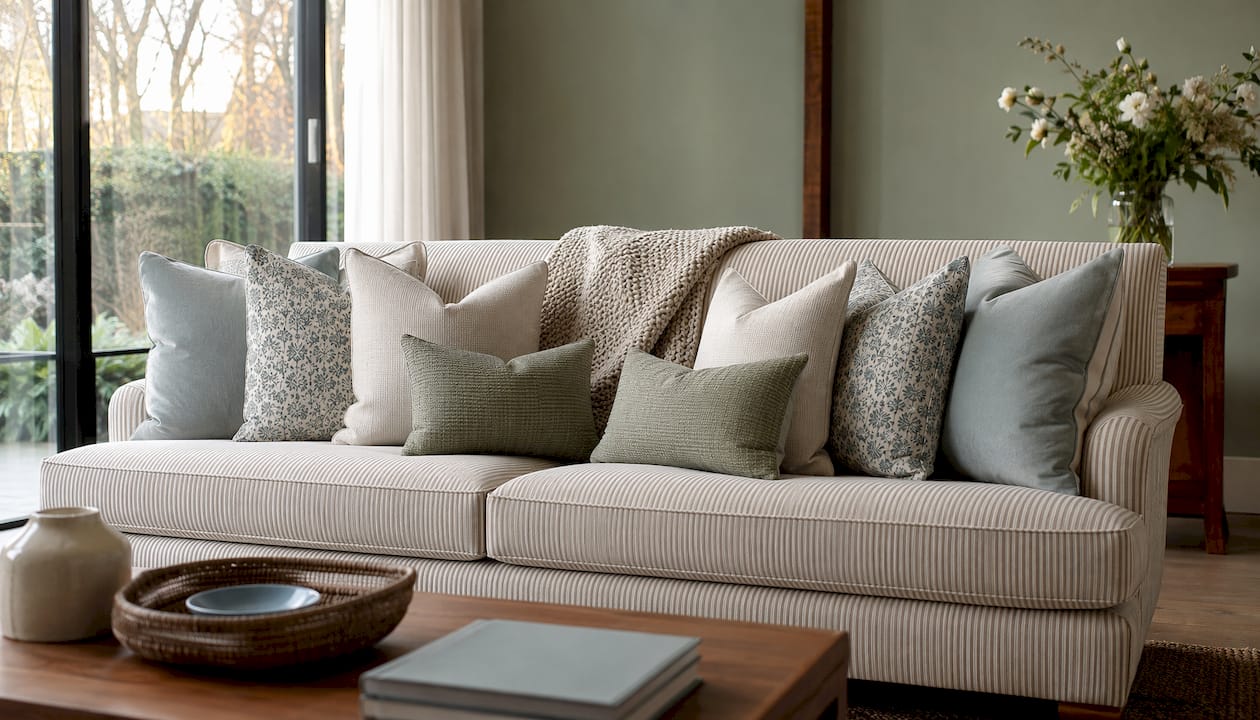
Layering within that framework is what separates a polished arrangement from a flat one. Start with your largest pillows, typically 22–24 inches, placed at the back corners. Bring a slightly smaller pillow, around 20 inches, in front of each anchor, overlapping rather than lining up beside it. That overlap is what creates depth. A lumbar pillow, roughly 12x20 or 14x24 inches, placed in front of or between the secondary pillows adds a final layer of visual interest and practical support.
Pro Tip: When you step back and look at the whole sofa, your eye should move across it evenly. If one side keeps pulling your attention first, the visual weight is off. Adjust by swapping a bold pattern to the quieter side, or by adding a textured pillow to balance a solid one.
- Place 22–24 inch anchor pillows at the back corners of the sofa.
- Layer a 20-inch pillow in front of each anchor, slightly overlapping.
- Add a lumbar or smaller accent pillow at the center or inside one end.
- Step back and check that visual weight feels even across both sides.
- Adjust pattern or color placement until neither side reads as louder than the other.
For seasonal and thematic refreshes, the beauty of throw pillows is that swapping covers costs a fraction of redecorating. Linen and cotton covers breathe well in warmer months; velvet and chunky knits bring warmth in fall and winter. The sofa stays constant; the mood of the room shifts with the light and the season.
Maintenance keeps the arrangement looking as good as the day you styled it. Fluff pillows regularly, rotating them so fill distributes evenly. For pillow covers, follow fabric-specific care instructions: performance fabrics, including the stain-resistant, bleach-cleanable options Striped Sofa Co. builds into its sofas, simplify cleaning considerably. Removable covers make seasonal swaps practical rather than precious.
Expert insights on choosing and styling throw pillows well
The single most overlooked detail in pillow styling is the insert. Pillow inserts should be 1–2 inches larger than the cover they fill. A 20-inch cover needs a 22-inch insert; a 22-inch cover needs a 24-inch insert. That extra fill is what gives a pillow its full, plump appearance rather than the deflated, pancake look that makes even beautiful fabric seem cheap.
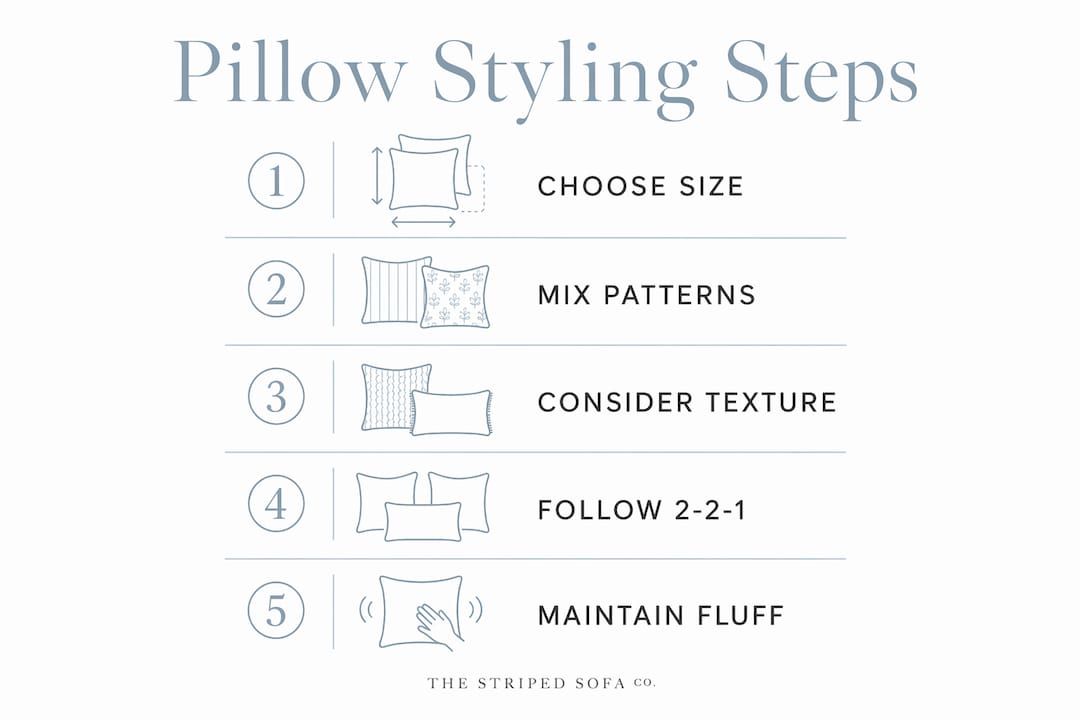
Fill type shapes both the look and the daily experience of the pillow. Down inserts create a softer, more relaxed silhouette that lends itself to the karate-chop finish many designers favor. Down alternative holds its shape more consistently and requires less daily fluffing, which suits households where the sofa sees heavy use. Neither is universally better; the choice depends on whether you want a lived-in warmth or a tidier, more structured look.
Scale sensitivity is where many homeowners lose confidence. Deeper sofas need larger pillows for proportionate scale; a 24-inch pillow that looks generous on a deep sectional would overwhelm a compact loveseat. Shallower or more tailored sofas tend to look best with slightly smaller pillows, around 18–20 inches, so the arrangement feels considered rather than crowded.
For sectional sofas, the corner is the natural focal point and can carry more and larger pillows than the ends. The ends benefit from restraint: anchor pillows and perhaps a mid-layer, with accent pillows kept minimal so the sectional doesn’t become a pillow warehouse.
Sustainable choices matter here too, in the same spirit that guides Striped Sofa Co.'s use of soy-based foam and FSC-certified wood. Choosing quality pillow inserts and durable covers from natural or responsibly sourced materials means fewer replacements over time, less waste, and a sofa that ages with genuine character rather than disposable trend.
- Oversize your insert by 1–2 inches for a full, polished look.
- Choose down for a relaxed, sculptural feel; down alternative for structure and easy maintenance.
- Match pillow scale to sofa depth: larger for deep sofas, smaller for tailored or shallow ones.
- On sectionals, concentrate visual weight at the corner and keep the ends lighter.
- Invest in quality covers and inserts; they outlast trends and hold their shape through years of gracious living.
The sofa that earns its pillows

A beautifully styled sofa begins with the sofa itself. At Striped Sofa Co., every piece is made to order in America, built on FSC and SFI certified wood with soy-based foam, and upholstered in stain-resistant, bleach-cleanable fabrics free from PFAS chemicals. The striped upholstery becomes the steady heartbeat of a room, a quiet foundation that holds whatever color story and pillow arrangement you bring to it. Whether you are drawn to the sweeping scale of The Chelsea or the refined proportions of a custom design, the fabric and form are built to carry layered beauty for years. Explore custom sofa design and find the piece your pillows have been waiting for.
Key Takeaways
Throw pillows serve both a functional and aesthetic role in sofa design, and getting both right requires attention to scale, color, texture, and insert quality.
| Point | Details |
|---|---|
| Color story first | Pull 3–5 colors from existing room elements to keep pillow choices cohesive without matching exactly. |
| Use the 2-2-1 rule | Two pillows at each sofa end plus one accent pillow in the center typically results in three to six pillows, creating balance for most three-seater sofas. |
| Oversize your inserts | Choose inserts 1–2 inches larger than the cover for a full, polished look that holds its shape. |
| Scale to sofa depth | Deeper sofas need 22–24 inch pillows; shallower or tailored sofas suit slightly smaller sizes. |
| Layer textures, not matches | Mixing velvet, linen, and knit adds depth that repeating the sofa’s own fabric never achieves. |