

Matching a sofa to existing decor is defined as aligning your sofa’s color temperature, scale, texture, and fabric with the established visual language of your room. The 60-30-10 color rule, recognized as the accepted standard for visual balance in interior design, gives you a reliable framework: 60% dominant neutral base, 30% secondary color or texture, and 10% accent. Most homeowners who struggle with a new sofa are not choosing the wrong style. They are ignoring undertones, scale, and light. Get those three right, and the room pulls together with quiet confidence.
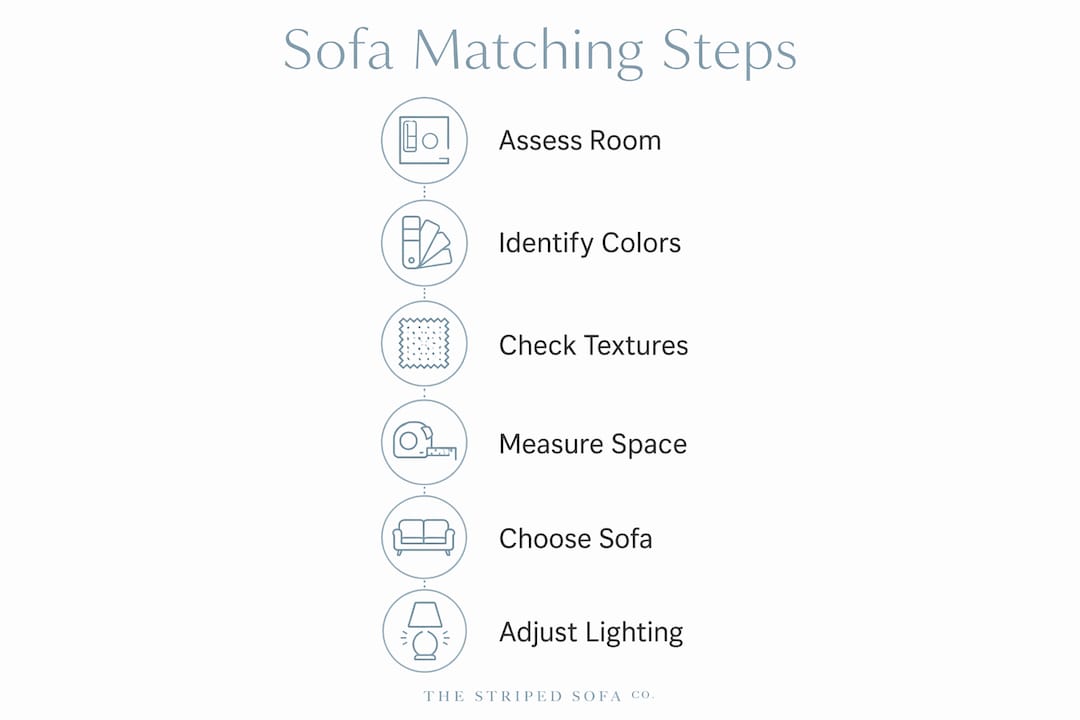
How to match sofa to existing decor: start with a room assessment
Experienced designers treat walls, flooring, and lighting as fixed anchors that guide every sofa choice. Your room already has a personality. Your job is to read it before you shop.

Identify your dominant colors and undertones
Every room has a dominant color temperature: warm or cool. Warm rooms lean toward honey oak floors, cream walls, and amber lighting. Cool rooms favor gray stone, white trim, and blue-toned light. The critical mistake most homeowners make is treating “neutral” as a universal category. Warm neutrals clash with cool neutrals even when both look beige at first glance. Hold a white piece of paper next to your wall color. If the wall looks yellow or pink by comparison, your room runs warm. If it looks blue or green, it runs cool.
Assess your textures and patterns
Stand in the center of your room and count the distinct textures you see: linen curtains, a jute rug, a wood coffee table, a knit throw. Each one competes for visual attention. A room already rich in pattern needs a sofa that acts as a visual pause, not another statement. Note whether your existing patterns are large-scale, medium, or fine. That hierarchy matters when you choose sofa upholstery.
Measure before you commit
Use this quick checklist before visiting any showroom or browsing online:
- Room dimensions: Length and width of the room in feet
- Sofa wall length: The wall where the sofa will sit, measured in feet
- Ceiling height: Affects visual weight of high-back versus low-profile sofas
- Doorway and hallway widths: Delivery clearance is non-negotiable
- Existing furniture heights: Sofa seat height should align within two inches of surrounding chairs
- Light sources: Note windows (direction and size) and overhead or lamp positions
| Room element | What to record | Why it matters |
|---|---|---|
| Wall color | Paint name and undertone | Guides sofa color temperature match |
| Floor material | Wood tone, tile color, or carpet hue | Anchors the 60% dominant base |
| Existing textiles | Rug, curtains, throw colors | Identifies secondary and accent tones |
| Light sources | Natural direction, bulb type | Affects how sofa fabric reads in the room |
| Pattern complexity | Number and scale of patterns | Determines sofa fabric complexity |
How do color and texture principles help you choose the right sofa?
The 60-30-10 rule distributes color across three tiers: 60% for your dominant base (walls, floors, and large sofa), 30% for secondary color through rugs and curtains, and 10% for accent pieces like pillows and art. Your sofa typically sits in that dominant 60% tier. That means it should reinforce the room’s base tone, not fight it.
Match color temperature first, style second
Color temperature mismatch creates discord even between neutral colors. A warm ivory sofa placed against cool gray walls will look “off” in ways that are hard to name but impossible to ignore. The fix is simple: identify whether your room runs warm or cool, then match sofa undertones to that same temperature family. A warm room calls for sofas in camel, warm white, terracotta, or sage with yellow undertones. A cool room suits sofas in slate blue, charcoal, cool greige, or soft white with gray undertones.
Balance texture with intention
Texture acts as a visual pause. A solid velvet sofa can anchor a room full of competing patterns because its surface reads as calm and unified. Linen works beautifully in rooms with natural wood and woven baskets. Bouclé adds softness to rooms with hard surfaces like marble or lacquered furniture. The goal is contrast without conflict.
Rooms should contain no more than 3–4 distinct textures arranged in a clear hierarchy: one large-scale, one medium, and one fine texture. If your room already has a bold geometric rug, a linen curtain, and a rattan side table, your sofa fabric should be the simplest element in the room.
Pro Tip: If your room features heavy pattern in rugs or curtains, choose a solid sofa fabric. The sofa becomes the quiet foundation that lets everything else breathe. You can always add personality through throw pillows.
Use bridging elements to connect sofa and room
Bridging is the technique of using rugs, pillows, and throws that contain both your sofa’s color and your room’s existing tones. A navy sofa in a room with warm wood floors and cream walls feels disconnected until you add a rug with cream, navy, and warm amber woven together. That rug becomes the visual handshake between the sofa and the room. Throw pillows in the room’s accent color pull the sofa into the broader palette. This technique works for almost any color mismatch short of a full temperature clash.
For fabric selection guidance that covers how upholstery interacts with room textures, the details matter more than most homeowners realize.
What scale and style factors affect sofa placement?
Scale mismatch disrupts room harmony more reliably than color mismatch. An oversized sofa crowds a room and makes every other piece look like an afterthought. A sofa that is too small floats in the space and loses its authority as the room’s anchor.
The standard guideline is that your sofa’s length should occupy roughly two-thirds of the wall it sits against. In a room with a 12-foot wall, a 96-inch sofa fits well. In a room with a 9-foot wall, a 72-inch sofa is the upper limit. Sofa depth also matters: deep, low-slung sofas suit casual, open rooms, while tighter, higher-backed sofas work better in formal or compact spaces.
Style alignment follows a similar logic. A curved, skirted sofa in a room full of angular, industrial furniture creates tension that no amount of throw pillows will resolve. Match the sofa’s design vocabulary to the room’s existing style. Rooms with clean lines and minimal ornament call for sofas with straight arms and simple profiles. Rooms with layered textiles, antiques, and warm wood call for sofas with more character: sloped arms, skirted bases, or tufted backs.
Follow these steps before purchasing any sofa:
- Measure the sofa wall and calculate two-thirds of its length as your maximum sofa size.
- Tape the sofa footprint on the floor using painter’s tape to visualize scale in the actual space.
- Check traffic flow by walking through the taped area. You need at least 30 inches of clearance around the sofa.
- Photograph the taped outline from the room’s main entry point. Scale problems are easier to spot in a photo than in person.
- Compare sofa arm and back height to your existing chairs and tables before ordering.
For help understanding sofa configuration options that suit different room sizes and layouts, the right shape matters as much as the right size.
How does lighting affect your sofa’s appearance in the room?
Lighting drastically alters perceived colors. North-facing rooms mute warm tones and require richer, deeper colors to compensate. South-facing rooms amplify warmth and can make already-warm sofas feel overwhelming by midday. A sofa that looked perfect in a showroom under bright halogen light may appear flat or gray in your living room under a single overhead bulb.
The most reliable fix after a sofa installation that looks “wrong” is adjusting your lighting before reconsidering the sofa itself. Swap overhead bulbs to 2700K warm white LEDs and add table lamps at sofa height to create localized warmth. Dimmers give you control over the room’s mood across different times of day.
Pro Tip: Before purchasing, bring a fabric swatch home and observe it at three different times: morning natural light, afternoon sun, and evening lamp light. A fabric that passes all three conditions will not surprise you after delivery.
After the sofa arrives, use these layering steps to unify the room:
- Add a rug that contains both the sofa color and at least one existing room tone.
- Layer throw pillows in the room’s secondary and accent colors.
- Hang artwork that echoes the sofa’s undertone, not just its hue.
- Introduce a plant to add a natural, neutral green that bridges almost any palette.
- Repaint one wall if the temperature mismatch is severe. A warm-toned sofa in a cool-gray room often needs a warmer wall color more than it needs new accessories.
“The room is an ecosystem. Every piece either contributes to the whole or competes with it. When a sofa looks wrong, the answer is almost never to remove it. The answer is to build the relationships around it.”
Key Takeaways
Matching a sofa to your room requires aligning color temperature, texture hierarchy, and scale before you purchase, then using bridging elements and lighting to unify the result.
| Point | Details |
|---|---|
| Color temperature first | Match sofa undertones to your room’s warm or cool base before considering style. |
| Apply the 60-30-10 rule | Place your sofa in the dominant 60% tier and build secondary and accent layers around it. |
| Limit texture complexity | Keep rooms to 3–4 distinct textures in a clear hierarchy to avoid visual chaos. |
| Scale to the wall | Size your sofa to roughly two-thirds of the wall it occupies for proper proportion. |
| Fix lighting before replacing | Adjusting bulbs to 2700K and adding table lamps often resolves a sofa that looks “off.” |
What I have learned from watching homeowners get this wrong
Every week I hear from someone who bought a beautiful sofa and cannot figure out why the room feels worse than it did before. The sofa is not the problem. The problem is that they bought it in isolation, the way you might buy a painting for a wall you have not measured.
The room is a relationship, not a collection. Designers have said this for decades, and homeowners keep ignoring it because it sounds abstract. Here is what it means in practice: your floors, walls, and existing furniture are not a backdrop. They are the dominant voice in the room. Your sofa needs to answer that voice, not talk over it.
The single most common mistake I see is temperature mismatch. Someone has a warm honey-toned room and falls in love with a cool gray sofa. Both are beautiful. Together, they fight. The gray reads cold and uninvited. The warm room looks muddy by comparison. No amount of throw pillows fixes a fundamental temperature clash. You have to go back to the undertones.
The second mistake is ignoring scale. A sofa that is six inches too long for a wall does not just look big. It changes the entire spatial logic of the room. Every other piece of furniture suddenly looks like it is apologizing for being there.
My honest recommendation: spend one hour assessing your room before you spend one minute browsing sofas. Photograph every wall. Note every undertone. Tape the footprint on the floor. That hour will save you months of living with a room that never quite feels right.
— Kevin O’Gara
Sofas designed to work with your room, not against it
Choosing a sofa that genuinely fits your existing decor is easier when you have real customization options, not just a fixed catalog of colors and sizes.

Striped Sofa Co builds each sofa to order in 6–8 weeks using American craftsmanship and FSC and SFI certified materials. Every piece is upholstered in stain-resistant, bleach-cleanable fabrics free from harmful PFAS chemicals, so your sofa performs as well as it looks. You choose the fabric, the scale, and the silhouette to match what your room already loves. The full sofa collection includes styles from the skirted and slope-armed Dalston to the flare-armed Chelsea, each designed to harmonize with diverse room aesthetics rather than dominate them.
FAQ
What is the 60-30-10 rule for sofa color?
The 60-30-10 rule divides room color into three tiers: 60% dominant base (walls, floors, large sofa), 30% secondary color (rugs, curtains), and 10% accent (pillows, art). Your sofa typically anchors the dominant 60% tier.
How do I know if my sofa color temperature matches my room?
Identify whether your room runs warm (honey wood, cream, amber) or cool (gray, white, blue-toned). Then match sofa undertones to the same temperature family. Warm neutrals and cool neutrals clash even when both appear beige.
What size sofa fits my living room?
Your sofa’s length should occupy roughly two-thirds of the wall it sits against. Tape the footprint on the floor before purchasing and confirm at least 30 inches of clearance on all sides for traffic flow.
Why does my new sofa look wrong in my room?
Lighting is the most common culprit. Lighting adjustments such as swapping bulbs to 2700K and adding table lamps often resolve the visual mismatch before any furniture change is needed.
How many textures should a living room have?
Rooms work best with 3–4 distinct textures arranged in a hierarchy of large, medium, and fine scale. A sofa in a texture-rich room should be the simplest surface in the space.