

Fabric pilling is defined as the formation of small fiber balls on a fabric surface, caused by friction rubbing loose fibers free until they tangle and anchor themselves to the yarn. It is one of the most common complaints homeowners have about upholstery, and it is entirely explainable by fiber science. Understanding what causes sofa fabric pilling means looking at three interconnected factors: the fiber itself, the way the yarn is constructed, and how the fabric is woven. Once you understand those three things, you can make smarter choices and keep your sofa looking the way it did the day it arrived.
What causes sofa fabric pilling at the fiber level?
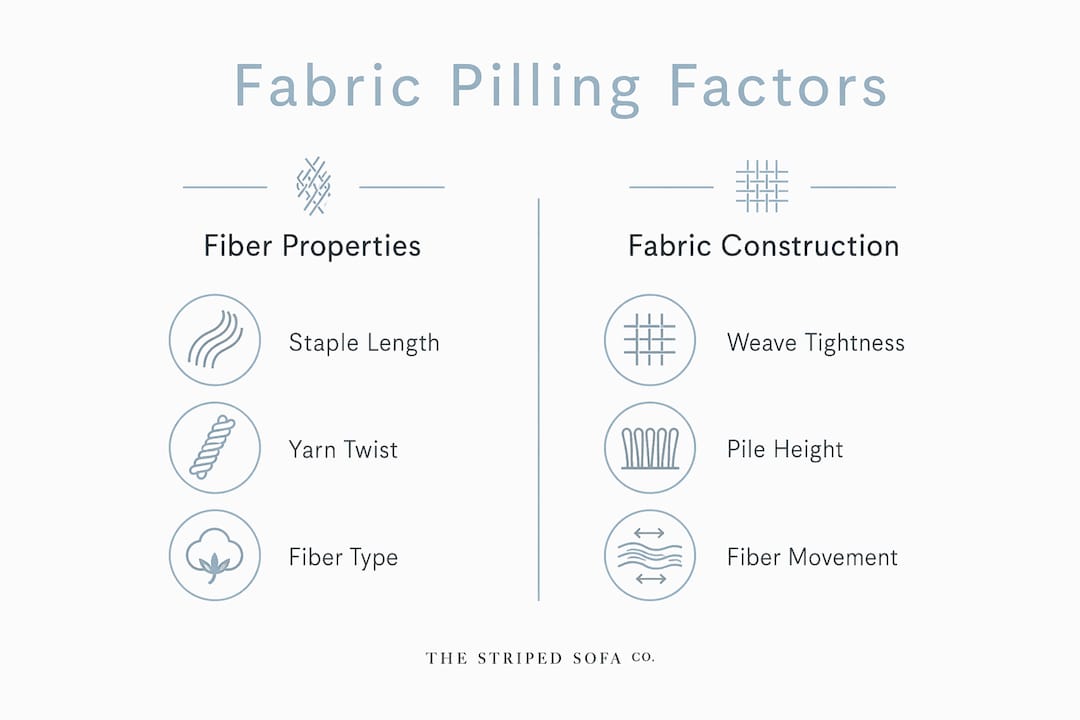
Pilling begins with the fiber, not the sofa. Short-staple fibers release loose ends far more easily than long-staple fibers, because their shorter length means more exposed tips per inch of yarn. Those exposed tips are what friction catches, lifts, and eventually tangles into pills.
Yarn twist matters just as much as fiber length. Low-twist yarns allow individual fibers to work free from the yarn bundle with very little abrasion. High-twist yarns bind fibers together tightly, giving them far less room to migrate to the surface. When you run your hand across a loosely twisted fabric and feel that soft, almost fluffy texture, you are actually feeling a fabric that is more vulnerable to pilling.
Fiber type determines how persistent those pills become once they form. Synthetic fibers anchor pills more strongly than natural fibers, because their tensile strength keeps the pill attached to the yarn even under continued use. Natural fibers like cotton and wool form pills too, but those pills tend to detach over time as the weaker fiber breaks. The pill disappears, but so does a little of the fabric.
Blended fabrics combine the worst of both worlds. The natural fiber component forms the pill while the synthetic component holds it in place. That is why a cotton-polyester blend often pills more noticeably and persistently than either fiber used alone.
- Short-staple fibers (cotton, carded wool) expose more fiber ends per inch, increasing pill formation.
- Low-twist yarns allow fibers to migrate freely to the surface.
- Synthetic fibers (polyester, acrylic, nylon) anchor pills strongly, making them persist.
- Natural fibers (cotton, linen, wool) form pills that may eventually detach, leaving surface wear instead.
- Blended fabrics combine pill formation from natural fibers with pill retention from synthetics.
Pro Tip: When shopping for upholstery fabric, ask specifically about yarn twist level and staple length. A fabric described as “tightly woven” is not the same as one made from high-twist yarn. Both matter, and you want both.
How does fabric construction affect pilling on sofas?
The way a fabric is woven or constructed controls how much individual fibers can move against each other. Loose or open weaves give yarn more room to shift on the surface, which increases fiber-to-fiber abrasion and accelerates pill formation. Dense, tight weaves restrict that movement and reduce the likelihood of pilling significantly.
Pile fabrics like velvet introduce another variable: pile height. Short, dense velvet piles have fewer exposed fiber ends than longer, open piles. That density acts as a kind of structural defense against pilling. Residential velvet often uses a longer, softer pile for comfort, while contract-grade velvet uses a shorter, denser pile for durability. The difference shows up clearly after a year of regular use.
| Construction type | Pilling risk | Why |
|---|---|---|
| Tight plain weave | Low | Restricts yarn movement and fiber abrasion |
| Loose open weave | High | Allows fibers to shift and tangle freely |
| Short dense velvet pile | Low | Fewer exposed fiber ends per surface area |
| Long soft velvet pile | High | More exposed fiber ends, more abrasion points |
| Tightly twisted yarn | Low | Fibers bound together, harder to loosen |
Pro Tip: Request a fabric sample and rub it firmly between your fingers for 30 seconds. If you see small fiber balls forming, that fabric will pill on your sofa. This simple test tells you more than any product description.
What role does sofa usage and friction play in fabric pilling?
Friction-induced fiber abrasion is the primary mechanical cause of pilling. Every time you sit down, shift position, or slide across a cushion, you are generating friction between your clothing and the sofa fabric. That friction breaks surface fibers loose from the yarn.
Once a fiber is loose, it does not simply fall away. It catches on neighboring fibers, wraps around them, and forms a small tangled knot. That knot stays attached because fibers still anchored inside the yarn hold it in place. Pills persist because of this anchoring effect, and they grow larger as more loose fibers accumulate around the original knot.
The areas of a sofa that receive the most friction pill first and worst. Seat cushions, armrests, and the back cushion area where people lean and shift are the most vulnerable zones. Cleaning methods also contribute. Scrubbing fabric with a stiff brush or rough cloth during cleaning generates the same kind of abrasion as daily use.
The ISO 12945-2 Martindale pilling test simulates these real-life friction cycles in a controlled setting, grading fabric pilling resistance on a scale from 5 (no pilling) to 1 (severe pilling). Fabric rated at grade 4 or 5 on this scale will hold up noticeably better in a family living room than fabric rated at grade 2 or 3.
- Sitting and shifting generates direct friction against seat and back cushions.
- Clothing textures (denim, rough knits) accelerate fiber abrasion compared to smooth fabrics.
- Pets and children create concentrated, repeated friction in specific spots.
- Aggressive cleaning with stiff brushes or rough cloths adds mechanical abrasion.
- Prolonged use makes pills more persistent, especially in synthetics and blends.
How do different upholstery fabrics compare in pilling susceptibility?
Not all upholstery fabrics pill at the same rate or in the same way. Synthetic fabrics like polyester and acrylic pill more noticeably and persistently than natural fibers, because their strength keeps pills firmly attached to the surface. A polyester sofa that pills will look progressively worse over time without regular maintenance.
Natural fibers like cotton and linen pill too, but their pills tend to detach as the fiber weakens and breaks. The fabric surface may look worn rather than pilled after extended use. Wool behaves similarly, forming pills that eventually shed, though wool’s natural crimp can slow the initial pill formation.
Blended fabrics, particularly cotton-polyester and wool-acrylic combinations, often pill worst because the natural fiber forms the pill while the synthetic fiber anchors it. This combination is common in mid-range upholstery fabrics, which is why so many homeowners notice pilling on sofas that seemed well-made at purchase.
Performance fabrics treated for stain resistance or durability can behave differently from their base fiber composition. A tightly woven, treated polyester performance fabric may resist pilling better than an untreated cotton blend, because the treatment and construction compensate for the fiber’s natural tendency to anchor pills. Checking the Martindale pilling grade for any upholstery fabric gives you an objective measure of how it will perform over time.
| Fabric type | Pilling tendency | Pill persistence |
|---|---|---|
| Polyester | High | Very persistent |
| Acrylic | High | Very persistent |
| Cotton | Moderate | Pills detach over time |
| Wool | Moderate | Pills shed gradually |
| Cotton-polyester blend | High | Very persistent |
| Performance treated polyester | Low to moderate | Reduced by construction |
What practical measures prevent or reduce sofa fabric pilling?
Preventing fabric pilling starts at the point of purchase. Choosing a fabric with high-twist yarn, dense weave construction, and a Martindale pilling grade of 4 or higher gives your sofa the best structural defense against pills before a single person sits down. The sofa care guide from Striped Sofa Co walks through the specific cleaning and maintenance practices that protect upholstery over the long term.
- Choose the right fabric from the start. Look for tightly woven fabrics with high-twist yarn and a Martindale pilling grade of 4 or 5. Ask for the spec sheet before you buy.
- Use throws or sofa covers in high-friction zones. Armrests and seat cushions take the most wear. A well-placed throw absorbs the friction that would otherwise hit the upholstery directly.
- Clean gently. Use a soft cloth or upholstery brush with light pressure. Scrubbing generates the same abrasion as daily use and accelerates pilling in already vulnerable areas.
- Rotate and flip cushions regularly. Distributing wear across the full cushion surface slows the concentration of friction in any one spot.
- Use a fabric shaver carefully. A fabric shaver removes existing pills without damaging the underlying weave, but only when used with light, even pressure. Heavy-handed use can thin the fabric surface.
- Vacuum with a soft brush attachment. Regular vacuuming removes loose fibers before they have a chance to tangle and form pills.
Pro Tip: Abrasion resistance and pilling resistance are not the same property. A fabric can score well on abrasion tests and still pill severely. Always ask specifically for the pilling grade, not just the abrasion rating, when evaluating upholstery.
Key Takeaways
Sofa fabric pilling is caused by friction loosening short-staple or low-twist fibers, which tangle and anchor to the yarn surface, with synthetic and blended fabrics producing the most persistent pills.
| Point | Details |
|---|---|
| Fiber type drives pill persistence | Synthetic fibers anchor pills strongly; natural fibers form pills that may detach over time. |
| Yarn twist and weave density matter | High-twist yarn and tight weaves restrict fiber movement and reduce pilling significantly. |
| Friction is the mechanical trigger | Daily sitting, shifting, and cleaning all generate the abrasion that loosens fibers and starts pills. |
| Blended fabrics pill worst | Natural fibers form pills while synthetic fibers hold them in place, making blends the most problematic. |
| Test before you buy | A Martindale pilling grade of 4 or 5 is the clearest objective indicator of how a fabric will perform. |
What I’ve learned about pilling after years of thinking about fabric
Most people blame pilling on poor quality. The truth is more nuanced. A beautifully soft, natural-feeling fabric can pill faster than a fabric that feels almost clinical in its firmness. Softness and pilling resistance are often in direct tension with each other, because the same fiber characteristics that make a fabric feel luxurious, loose twist, fine staple, open weave, are the ones that make it vulnerable.
What I tell people who ask me about fabric choices is this: understand the blend before you fall in love with the hand feel. A fabric that feels incredible in the showroom may look tired within a year if it is a loosely twisted cotton-polyester blend. The ISO 12945-2 Martindale grade is not glamorous information, but it is honest information. I have come to trust it more than any tactile impression.
Pilling is also not a sign that a sofa is failing. It is a sign that the fabric is being used. The goal is not to eliminate pilling entirely but to choose and maintain a fabric that resists it long enough to earn its place in your home. A good fabric shaver, a gentle cleaning routine, and cushion rotation can extend the life of almost any upholstery. The sofa that serves as both foundation and friend in your living room deserves that kind of attention.
— Kevin O’Gara
Sofas built with fabrics that resist the test of time
At Striped Sofa Co, every sofa is made to order in America using performance upholstery fabrics selected for durability, not just appearance. The fabrics are stain-resistant, bleach-cleanable, and free from harmful PFAS chemicals, which means they are built to hold up under real daily use without sacrificing the layered beauty that makes a room feel like home.
If you have spent time thinking about what causes sofa fabric pilling, you already understand why fabric construction matters as much as frame quality. The custom performance sofas at Striped Sofa Co are designed with that understanding built in, from fiber selection to finished cushion. You can also explore the woven pinstripe performance fabric by the yard to feel the difference that tight construction makes before you commit to a full sofa order.
FAQ
What causes sofa fabric pilling in the first place?
Pilling is caused by friction loosening short-staple or low-twist fibers from the yarn surface, where they tangle into small balls and remain anchored by fibers still inside the yarn. Daily sitting, shifting, and cleaning all generate this friction.
Does fabric pilling mean my sofa is low quality?
Not necessarily. Even well-made sofas pill if the upholstery fabric uses a loose weave, low-twist yarn, or a synthetic-natural fiber blend. Pilling reflects fiber and construction characteristics more than overall sofa quality.
Which sofa fabrics pill the most?
Blended fabrics combining natural and synthetic fibers, such as cotton-polyester, pill most persistently because natural fibers form the pills while synthetic fibers anchor them to the surface.
How do I stop my sofa fabric from pilling further?
Rotate and flip cushions regularly, clean with a soft cloth using light pressure, and use a fabric shaver to remove existing pills. Choosing a fabric with a Martindale pilling grade of 4 or 5 is the most effective long-term prevention.
Is abrasion resistance the same as pilling resistance?
No. Abrasion and pilling resistance are distinct properties tested separately. A fabric can score well on abrasion tests and still pill severely, so always ask for the specific pilling grade when evaluating upholstery.